Marcian
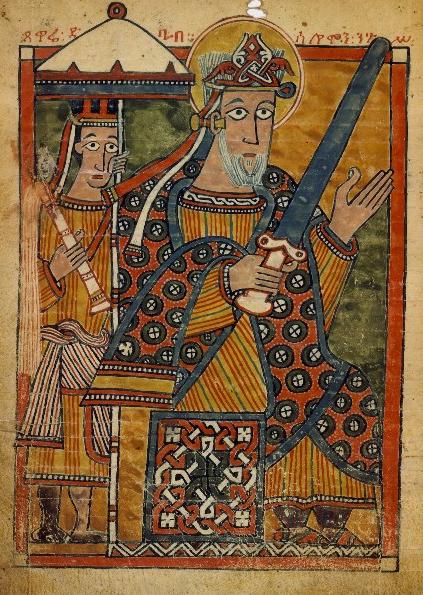
(Marcianus, Μαρκιᾶνος), Roman Emperor at Constantinople, born in Thrace about 390; died January, 457.
He became a soldier; during his early life he was poor, and it is said that he arrived at Constantinople with only two hundred pieces of gold, which he had borrowed. He served in the army under Ardaburius the Alan and his son Aspar; he distinguished himself in the wars against the Persians and Huns. Aspar was a kind of king-maker, and general- in-chief for the East (magister militum per orientem), also for a time the most powerful man at Constantinople. But since he was a foreigner and an Arian he could not be emperor himself. Instead he placed a succession of his favourites on the throne. One of these was Marcian. At Constantinople Marcian became a senator and was a well-known and popular person. He was a widower; his daughter by the first marriage, Euphemia, afterwards married Anthemius, Emperor in the West (467-472). He was about sixty years old when Theodosius II died (450).
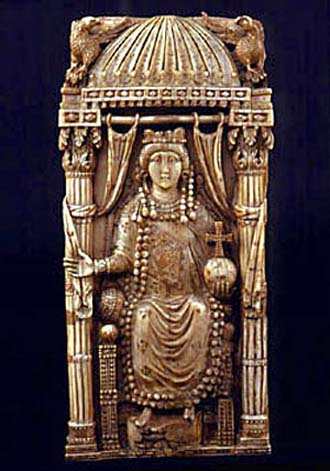 Theodosius II (408-450) had succeeded his father, Arcadius (395-408), as a young child. During the greater part of his reign his elder sister Pulcheria managed the Government. Already during the reign of Theodosius Pulcheria was “Augusta”. With her two sisters, Arcadia and Marina, she made a public vow of celibacy. When her brother died all difficulty about the succession was ended by the unanimous choice of her (who had long really guided the State) as empress. Thus began the reign of Pulcheria. Wishing to strengthen her position (it was the first case of a woman succeeding to the Roman throne) she at once made a nominal marriage with Marcian. He seems to have been the best person she could have chosen; the friendship of Aspar as well as his own reputation had long pointed him out for some high place. It is said that Theodosius on his death-bed had told him: “It has been revealed to me that you will succeed me.” Marcian was crowned by the patriarch, 25 August, 450. It is the first instance of the religious ceremony of coronation, imitated later in the West, and was to have far-reaching consequences. The first act of the new reign was the trial and execution of Chrysaphius, a eunuch and court favourite long unpopular, who had brought Theodosius to a humiliating apology and the payment of a large fine by an unsuccessful conspiracy to murder Attila. Marcian belonged to the party of reform, of which the founder, under Theodosius, had been Anthemius. As soon as he became emperor he began a policy of moderation, especially in taxation, that made his reign prosperous and himself popular, though he did little by force of arms to repress the ever-encroaching Huns and other enemies of Rome.
He reduced the expenses of the treasury and Court, and did away with the gleba, or follis, an opressive tax on property that was specially obnoxious to the upper classes. There was a harsh system by which any senator might be forced to accept the unwelcome honour of the prætura. As a prætor he was obliged to live at Constantinople during his time of office, and spend large sums on providing games and shows. This was specially hard on senators who lived in the provinces, who had therefore to come to the capital and live for months there at ruinous expense. Marcian modified this law so as to excuse people living away from the city, and he ordered the consuls to take their share of the expenses. He reformed the navy on a more economical basis. There were at that time frequent earthquakes, by which whole cities were destroyed. In these cases Marcian and Pulcheria came to the help of the sufferers generously with supplies from the imperial treasury.
Marcian had a conscientious idea of the responsibilities of his office. In the second novella of his code he defines his view of an emperor’s duty: “It is our business to provide for the care of the human race.” And he was conscious of the distress caused by the excessive taxation and general maladministration of his predecessors. The first novella announces that complainants have flocked to the Government from all sides, there are “endless crowds of petitioners”; this is because of the want of “integrity and severity” in the judges. Marcian’s laws are well-meant and successful attempts to cope with these difficulties. A very popular measure was his refusal to pay to Attila the tribute that had been paid regularly by Theodosius II. This refusal both saved a great expense and restored the dignity of the empire that had been degraded by so great a humiliation. As the Huns were just beginning their quarrel with the Franks, they could not afford to go to war with the empire. No doubt Marcian knew this when he defied them.
But the chief event of this reign was the beginning of the great Monophysite quarrel and the Council of Chalcedon. Marcian was conspicuously pious and orthodox. As soon as he was crowned he wrote a very friendly and respectful letter to Pope Leo I (440-461), whom he calls the guardian of the Faith, asking for his prayers, and declaring himself anxious to support the council proposed by the pope (soû a’uthentoûntos) in order to settle the question raised by Eutyches, Dioscurus, and their friends (ep. lxxiii among St. Leo’s letters; Mansi, VI, 99). Pulcheria also wrote; she too says that the council shall be summoned by the pope’s authority. Leo had already asked Theodosius II to summon the council (ep. xliv, 3; P. L., LIV, 826); Marcian clearly only meant to carry out this commission as Theodosius’s successor. Meanwhile Dioscurus and his party knew quite well that Marcian would not be their friend. They had tried and failed to prevent his recognition in Egypt; the attempt only made their case worse with the Government.
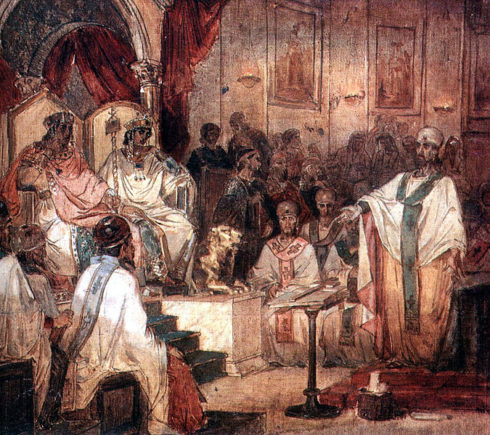
Council of Chalcedon
The Eastern Church had been disturbed by the teaching of Eutyches since immediately after the Council of Ephesus (431) and the Nestorian troubles. In 448 Eusebius of Dorylæum had accused Eutyches and his formula “one nature after the union” (metà tèn ‘énosin mía phúsis) at Constantinople. Dioscurus of Alexandria had taken up the cause of Eutyches, and had condemned Dyophysism at the Robber Council of Ephesus in 449 (for all this see ). Pope Leo hoped for a time to restore peace without another general council (his letters to Marcian, lxxviii, to Pulcheria, lxxix, and to the Patriarch Anatolius of Constantinople, lxxx). But meanwhile Marcian, acting on Leo’s former proposal, summoned a council on 17 May, 451, by letters addressed to all the metropolitans of the empire. It is clear that he acted on a misunderstanding, and had not yet received the pope’s later letter (Hefele-Leclercq, II, 639). Leo then accepted what had happened, and appointed as his legates Paschasius, Bishop of Lilybæum in Sicily, and a priest Boniface (ep. lxxxix; Mansi, VI, 125). The council was to have met at Nicæa; many bishops had already arrived there in the summer of 451, when the emperor wrote to tell them to wait till he could join them (his letter in Mansi, VI, 553). He was busy at the frontier of the empire arranging its defence against the Huns. The bishops wrote to complain of the delay, and Marcian answered their letter telling them to go to Chalcedon, opposite the capital on the other side of the Bosphorus (Mansi, V, 557); in this way he could attend to the council without leaving Constantinople.
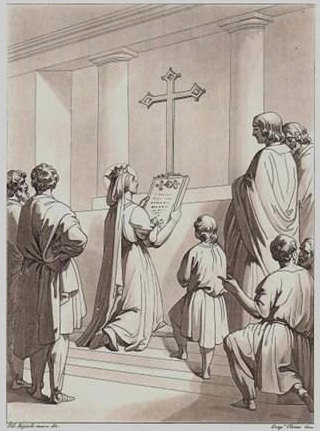
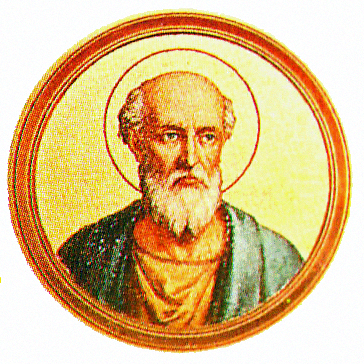
St. Pulcheria
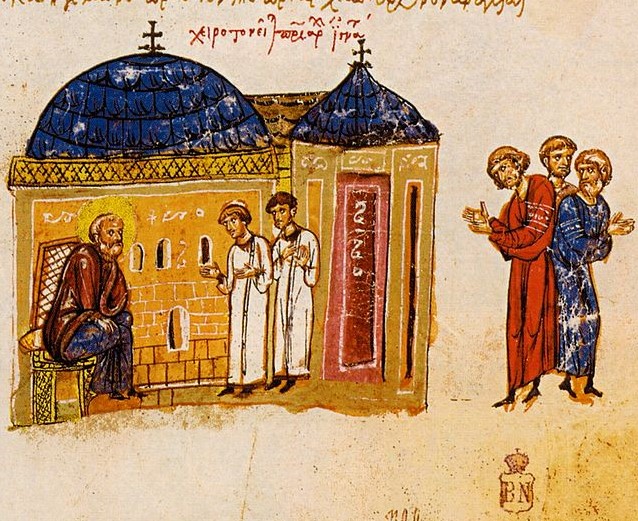
The council opened in the church of St. Euphemia at Chalcedon on 8 October, 451, and lasted till 1 November. About 600 bishops attended. The imperial commissioners were present and regulated the exterior business at each session. The papal legate, Paschasius, opened the council. Marcian and Pulcheria assisted at the sixth session (25 October). The emperor opened the proceedings that day with a speech in Latin (Mansi, VII, 129). One notices that what was still the official language of the empire was used on specially solemn occasions. His speech was then repeated in Greek. At this session the decree of the council was read (see .) On 27 February, 452, Marcian, together with his Western colleague, Valentinian III (423-455), made a law enforcing the decree and canons of the council as the law of the empire, and threatening heavy penalties against all who disputed them. Marcian alone repeated the same law on 13 March (Mansi, VII, 475- 480). The famous twenty-eighth canon (giving Constantinople rank immediately after Rome) and the pope’s protest against it caused further correspondence between him and the emperor and empress (Ep. Leonis I., cv, cvi; Mansi, VI, 187, 195), but did not disturb their good relations. Marcian’s laws produced uniformity at Constantinople and in the neighbourhood of the Government, but he could not enforce them so successfully in Syria and Egypt. The rest of his reign was troubled by the revolution in these provinces, which remained one of the chief difficulties of the Government under his successors for two centuries. Marcian made no concessions towards the Syrian and Egyptian Monophysites. His Government carried out the deposition of Dioscurus, and an edict of 28 July, 452, insisted under heavy penalties on the recognition of Proterius, the Orthodox Patriarch of Alexandria. A large force (2000 soldiers) was sent to Egypt. It was not until after Marcian’s death that a party at Constantinople under Aspar and Anatolius began to compromise with the heretics.
 In the year 453 Attila died. It is said that Marcian dreamed, at the moment of Attila’s death, that he saw the bow of his great enemy broken. The Empress Pulcheria died in the same year. She is canonized by both Catholics and Orthodox; her feast is on 10 September in both calendars. Marcian survived his wife four years. The end of his reign was occupied by the increasing troubles in Egypt. He was succeeded by Leo I (457-474). Marcian was, by marriage, the last emperor of the House of Theodosius I. The Orthodox have canonized him also, and keep his feast (with Pulcheria) on 17 February.
Evagrius, Hist. Eccl., II; Tillemont, Histoire des Empereurs, VI; Bury, History of the Later Roman Empire, I (London, 1889), 135-136; Gibbon, The Decline and Fall of the Roman Empire, with Bury’s notes, III (London, 1907), 444-474; Hefele, tr. Leclercq, Histoire des Conciles, II (Paris, 1908).
Adrian Fortescue (Catholic Encyclopedia)