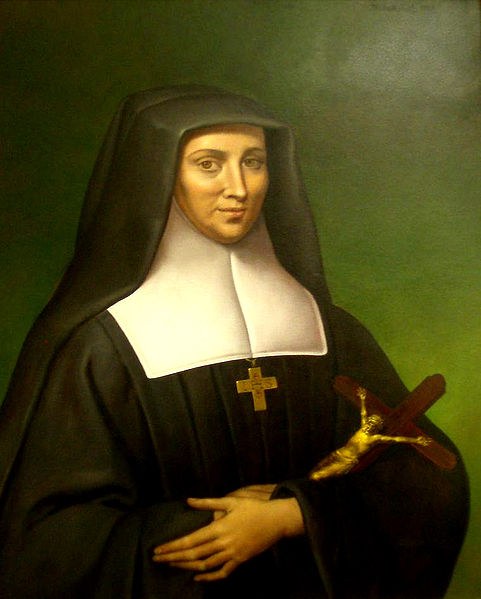
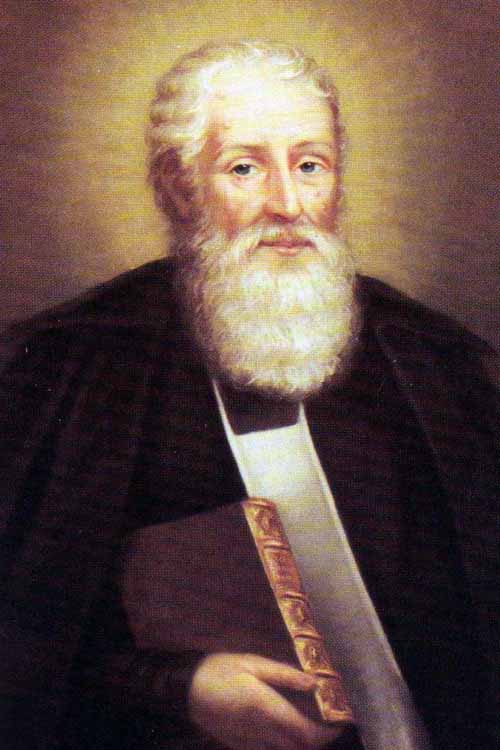
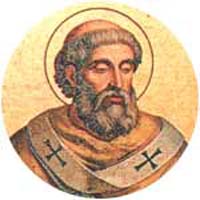
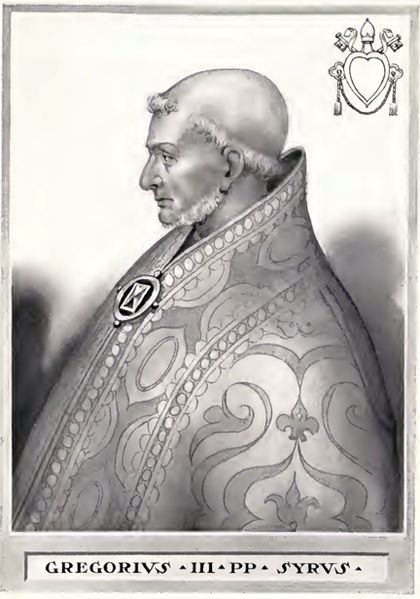
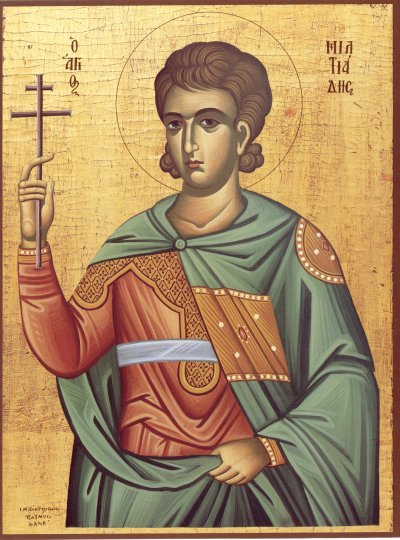
St. John Damascene

St. John of Damascus

Born at Damascus, about 676; died some time between 754 and 787. The only extant life of the saint is that by John, Patriarch of Jerusalem, which dates from the tenth century (P.G. XCIV, 429-90). This life is the single source from which have been drawn the materials of all his biographical notices. It is extremely unsatisfactory from the standpoint of historical criticism. An exasperating lack of detail, a pronounced legendary tendency, and a turgid style are its chief characteristics. Mansur was probably the name of John’s father. What little is known of him indicates that he was a sterling Christian whose infidel environment made no impression on his religious fervour. Apparently his adhesion to Christian truth constituted no offence in the eyes of his Saracen countrymen, for he seems to have enjoyed their esteem in an eminent degree, and discharged the duties of chief financial officer for the caliph, Abdul Malek. The author of the life records the names of but two of his children, John and his half-brother Cosmas. When the future apologist had reached the age of twenty-three his father cast about for a Christian tutor capable of giving his sons the best education the age afforded. In this he was singularly fortunate. Standing one day in the market-place he discovered among the captives taken in a recent raid on the shores of Italy a Sicilian monk named Cosmas. Investigation proved him to be a man of deep and broad erudition. Through the influence of the caliph, Mansur secured the captive’s liberty and appointed him tutor to his sons. Under the tutelage of Cosmas, John made such rapid progress that, in the enthusiastic language of his biographer, he soon equalled Diophantus in algebra and Euclid in geometry. Equal progress was made in music, astronomy, and theology.

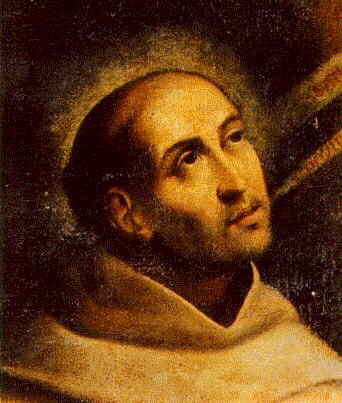
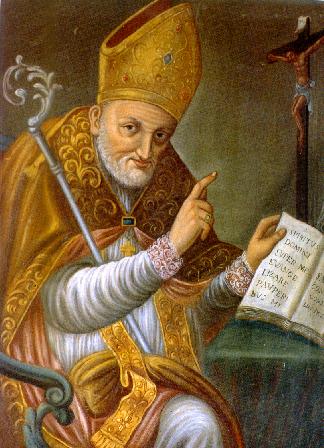
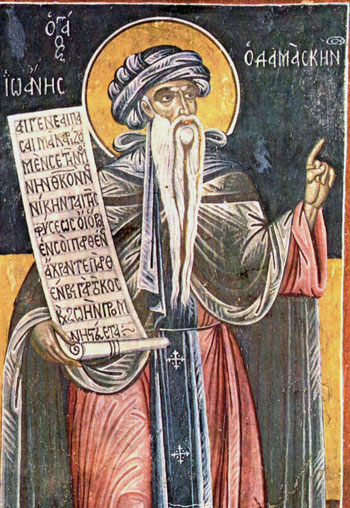
St. John of Damascus and St. Cosmas Bishop of Maiouma

St. John of Damascus and St. Cosmas Bishop of Maiouma

On the death of his father, John Damascene was made protosymbulus, or chief councillor, of Damascus. It was during his incumbency of this office that the Church in the East began to be agitated by the first mutterings of the Iconoclast heresy. In 726, despite the protests of Germanus, Patriarch of Constantinople, Leo the Isaurian issued his first edict against the veneration of images. From his secure refuge in the caliph’s court, John Damascene immediately entered the lists against him, in defense of this ancient usage of the Christians. Not only did he himself oppose the Byzantine monarch, but he also stirred the people to resistance. In 730 the Isaurian issued a second edict, in which he not only forbade the veneration of images, but even inhibited their exhibition in public places. To this royal decree the Damascene replied with even greater vigour than before, and by the adoption of a simpler style brought the Christian side of the controversy within the grasp of the common people. A third letter emphasized what he had already said and warned the emperor to beware of the consequences of this unlawful action. Naturally, these powerful apologies aroused the anger of the Byzantine emperor. Unable to reach the writer with physical force, he sought to encompass his destruction by strategy. Having secured an autograph letter written by John Damascene, he forged a letter, exactly similar in chirography, purporting to have been written by John to the Isaurian, and offering to betray into his hands the city of Damascus. The letter he sent to the caliph. Notwithstanding his councillor’s earnest avowal of innocence, the latter accepted it as genuine and ordered that the hand that wrote it be severed at the wrist. The sentence was executed, but, according to his biographer, through the intervention of the Blessed Virgin, the amputated hand was miraculously restored.

St. John of DamascusThe caliph, now convinced of John’s innocence, would fain have reinstated him in his former office, but the Damascene had heard a call to a higher life, and with his foster-brother entered the monastery of St. Sabas, some eighteen miles south-east of Jerusalem. After the usual probation, John V, Patriarch of Jerusalem, conferred on him the office of the priesthood. In 754 the pseudo-Synod of Constantinople, convened at the command of Constantine Copronymus, the successor of Leo, confirmed the principles of the Iconoclasts and anathematized by name those who had conspicuously opposed them. But the largest measure of the council’s spleen was reserved for John of Damascus. He was called a “cursed favourer of Saracens”, a “traitorous worshipper of images”, a “wronger of Jesus Christ”, a “teacher of impiety”, and a “bad interpreter of the Scriptures”. At the emperor’s command his name was written “Manzer” (Manzeros, a bastard). But the Seventh General Council of Nicea (787) made ample amends for the insults of his enemies, and Theophanes, writing in 813, tells us that he was surnamed Chrysorrhoas (golden stream) by his friends on account of his oratorical gifts. In the pontificate of Leo XIII he was enrolled among the doctors of the Church. His feast is celebrated on 27 March.

John of Damascus was the last of the Greek Fathers. His genius was not for original theological development, but for compilation of an encyclopedic character. In fact, the state of full development to which theological thought had been brought by the great Greek writers and councils left him little else than the work of an encyclopedist; and this work he performed in such manner as to merit the gratitude of all succeeding ages. Some consider him the precursor of the Scholastics, whilst others regard him as the first Scholastic, and his “De fide orthodoxa” as the first work of Scholasticism. The Arabians too, owe not a little of the fame of their philosophy to his inspiration. The most important and best known of all his works is that to which the author himself gave the name of “Fountain of Wisdom” (pege gnoseos). This work has always been held in the highest esteem in both the Catholic and Greek Churches. Its merit is not that of originality, for the author asserts, at the end of the second chapter of the “Dialectic”, that it is not his purpose to set forth his own views, but rather to collate and epitomize in a single work the opinions of the great ecclesiastical writers who have gone before him. A special interest attaches to it for the reason that it is the first attempt at a summa theologica that has come down to us.

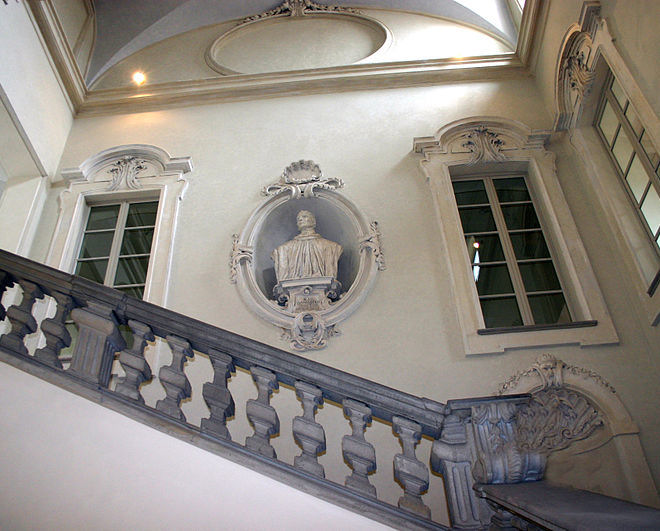
A bust of Saint John of Damascus, in the staircase of the former convent of San Simpliciano monastery in Milan, currently housing the Faculty of Theology. Picture by Giovanni Dall'Orto

A bust of Saint John of Damascus, in the staircase of the former convent of San Simpliciano monastery in Milan, currently housing the Faculty of Theology. Picture by Giovanni Dall’Orto

The “Fountain of Wisdom” is divided into three parts, namely, “Philosophical Chapters” (Kephalaia philosophika), “Concerning Heresy” (peri aipeseon), and “An Exact Exposition of the Orthodox Faith” (Ikdosis akribes tes orthodoxou pisteos). The title of the first book is somewhat too comprehensive for its contents and consequently is more commonly called “Dialectic”. With the exception of the fifteen chapters that deal exclusively with logic, it has mostly to do with the ontology of Aristotle. It is largely a summary of the Categories of Aristotle with Porphyry’s “Isagoge” (Eisagoge eis tas kategorias). It seems to have been John Damascene’s purpose to give his readers only such philosophical knowledge as was necessary for understanding the subsequent parts of the “Fountain of Wisdom”. For more than one reason the “Dialectic” is a work of unusual interest. In the first place, it is a record of the technical terminology used by the Greek Fathers, not only against the heretics, but also in the exposition of the Faith for the benefit of Christians. It is interesting, too, for the reason that it is a partial exposition of the “Organon”, and the application of its methods to Catholic theology a century before the first Arabic translation of Aristotle made its appearance. The second part, “Concerning Heresy”, is little more than a copy of a similar work by Epiphanius, brought up to date by John Damascene. The author indeed expressly disclaims originality except in the chapters devoted to Islamism, Iconoclasm, and Aposchitae. To the list of eighty heresies that constitute the “Panarion” of Epiphanius, he added twenty heresies that had sprung up since his time. In treating of Islamism he vigorously assails the immoral practices of Mohammed and the corrupt teachings inserted in the Koran to legalize the delinquencies of the prophet. Like Epiphanius, he brings the work to a close with a fervent profession of Faith. John’s authorship of this book has been challenged, for the reason that the writer, in treating of Arianism, speaks of Arius, who died four centuries before the time of Damascene, as still living and working spiritual ruin among his people. The solution of the difficulty is to be found in the fact that John of Damascene did not epitomize the contents of the “Panarion”, but copied it verbatim. Hence the passage referred to is in the exact words of Epiphanius himself, who was a contemporary of Arius.

“Concerning the Orthodox Faith”, the third book of the “Fountain of Wisdom”, is the most important of John Damascene’s writings and one of the most notable works of Christian antiquity. Its authority has always been great among the theologians of the East and West. Here, again, the author modestly disavows any claim of originality — any purpose to essay a new exposition of doctrinal truth. He assigns himself the less pretentious task of collecting in a single work the opinions of the ancient writers scattered through many volumes, and of systematizing and connecting them in a logical whole. It is no small credit to John of Damascus that he was able to Subscription20give to the Church in the eighth century its first summary of connected theological opinions. At the command of Eugenius III it was rendered into Latin by Burgundio of Pisa, in 1150, shortly before Peter Lombard’s “Book of Sentences” appeared. This translation was used by Peter Lombard and St. Thomas Aquinas, as well as by other theologians, till the Humanists rejected it for a more elegant one. The author follows the same order as does Theodoret of Cyrus in his “Epitome of Christian Doctrine”. But, while he imitates the general plan of Theodoret, he does not make use of his method. He quotes, not only form the pages of Holy Writ, but also from the writings of the Fathers. As a result, his work is an inexhaustible thesaurus of tradition which became the standard for the great Scholastics who followed. In particular, he draws generously from Gregory of Nazianzus, whose works he seems to have absorbed, from Basil, Gregory of Nyssa, Cyril of Alexandria, Leo the Great, Athanasius, John Chrysostum, and Epiphanius. The work is divided into four books. This division, however, is an arbitrary one neither contemplated by the author nor justified by the Greek manuscript. It is probably the work of a Latin translator seeking to accommodate it to the style of the four books of Lombard’s “Sentences”.

Read More

{ 0 comments }

December 4 – Saint Barbara

December 4, 2025

Saint Barbara

Virgin and Martyr. There is no reference to St. Barbara contained in the authentic early historical authorities for Christian antiquity, neither does her name appear in the original recension of St. Jerome’s martyrology. Veneration of the saint was common, however, from the seventh century. At about this date there were in existence legendary Acts of her martyrdom which were inserted in the collection of Symeon Metaphrastes and were used as well by the authors (Ado, Usuard, etc.) of the enlarged martyrologies composed during the ninth century in Western Europe. According to these narratives, which are essentially the same, Barbara was the daughter of a rich heathen named Dioscorus. She was carefully guarded by her father who kept her shut up in a tower in order to preserve her from the outside world. An offer of marriage which was received through him she rejected. Before going on a journey her father commanded that a bath-house be erected for her use near her dwelling, and during his absence Barbara had three windows put in it, as a symbol of the Holy Trinity, instead of the two originally intended.

The United States Army Field Artillery Association and the United States Army Air Defense Artillery Association maintain the Order of Saint Barbara as an honorary military society of the United States Army Field Artillery and the United States Army Air Defense Artillery. Members of both United States Marine Corps and United States Army, along with their military and civilian supporters, are eligible for membership. The most distinguished level is the Ancient Order of Saint Barbara and those who are selected for this honor have achieved long-term, exceptional service to the field artillery surpassing even their brethren in the Honorable Order of Saint Barbara.

When her father returned she acknowledged herself to be a Christian; upon this she was ill-treated by him and dragged before the prefect of the province, Martinianus, who had her cruelly tortured and finally condemned her to death by beheading. The father himself carried out the death-sentence, but in punishment for this he was struck by lightning on the way home and his body consumed. Another Christian named Juliana suffered the death of a martyr along with Barbara. A pious man called Valentinus buried the bodies of the saints; at this grave the sick were healed and the pilgrims who came to pray received aid and consolation. The emperor in whose reign the martyrdom is placed is sometimes called Maximinus and sometimes Maximianus; owing to the purely legendary character of the accounts of the martyrdom, there is no good basis for the investigations made at an earlier date in order to ascertain whether Maximinus Thrax (235-238) or Maximinus Daza (of the Diocletian persecutions), is meant.

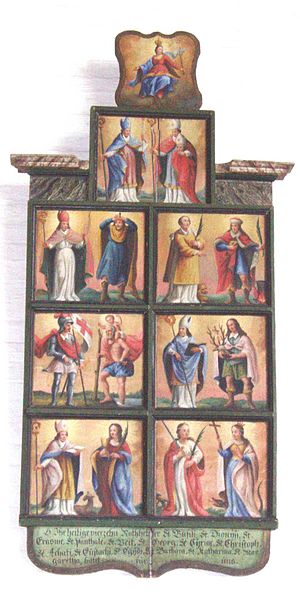
St. Barbara is one of the Fourteen Holy Helpers, because of their intercession against various diseases. Devotion to them originated in the 14th century at first in the Rhineland, as a result of the epidemic known as the Black Plague. Though each Saint has their own feast day, collectively their feast day is August 8th. The Basilica of the Fourteen Holy Helpers is located in Bavaria.

The traditions vary as to the place of martyrdom, two different opinions being expressed: Symeon Metaphrastes and the Latin legend given by Mombritius makes Heliopolis in Egypt the site of the martyrdom, while other accounts, to which Baronius ascribes more weight, give Nicomedia. In the “Martyrologium Romanum parvum” (about 700), the oldest martyrology of the Latin Church in which her name occurs, it is said: “In Tuscia Barbarae virginis et martyris”, a statement repeated by Ado and others, while later additions of the martyrologies of St. Jerome and Bede say “Romae Barbarae virginis” or “apud Antiochiam passio S. Barbarae virg.”. These various statement prove, however, only the local adaptation of the veneration of the saintly martyr concerning whom there is no genuine historical tradition. It is certain that before the ninth century she was publicly venerated both in the East and in the West, and that she was very popular with the Christian populace.

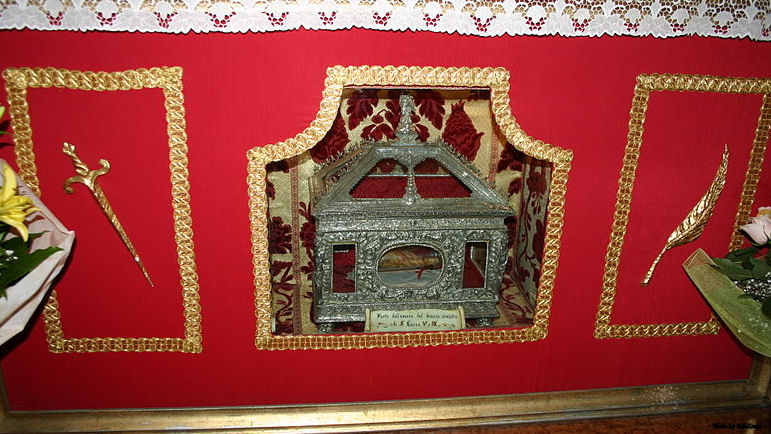
In the 12th century, the relics of Saint Barbara were brought from Constantinople to the St. Michael’s Golden-Domed Monastery in Kiev, where they were kept until the 1930s, when they were transferred to St. Vladimir’s Cathedral in the same city.

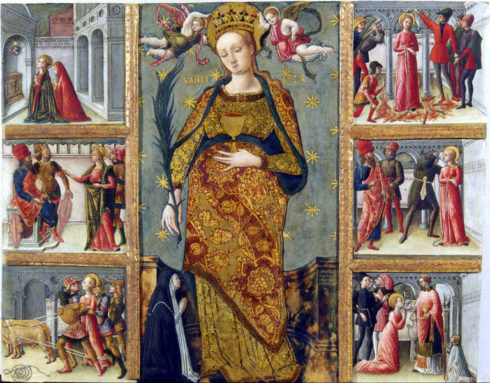
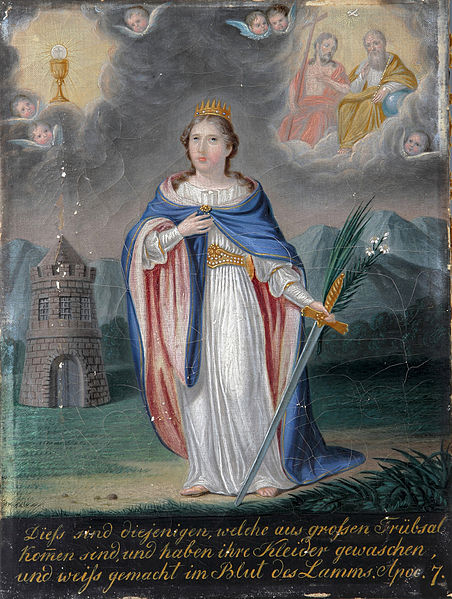
The legend that her father was struck by lightning caused her, probably, to be regarded by the common people as the patron saint in time of danger from thunder-storms and fire, and later by analogy, as the protector of artillerymen and miners. She was also called upon as intercessor to assure the receiving of the Sacraments of Penance and Holy Eucharist at the hour of death. An occurrence of the year 1448 did much to further the spread of the veneration of the saint. A man named Henry Kock was nearly burnt to death in a fire at Gorkum; he called on St. Barbara, to whom he had always shown great devotion. She aided him to escape from the burning house and kept him alive until he could receive the last sacraments. A similar circumstance is related in an addition to the “Legenda aurea”. In the Greek and present Roman calendars the feast of St. Barbara falls on 4 December, while the martyrologies on the ninth century, with exception of Rabanus Maurus, place it on 16 December. St. Barbara has often been depicted in art; she is represented standing in a tower with three windows, carrying the palm of a martyr in her hand; often also she holds a chalice and sacramental wafer; sometimes cannon are displayed near her.

Statue of St. Barbara in Paterno, Sicily. She is Paterno’s Patron Saint, along with St. Vincent.

Passio, in SYMEON METAPHRASES (Migne, P.G., CXVI, col.301 sqq.); MOMBRITIUS, Vitae sanctorum (Venice, 1474), I, fol.74, SURIUS, Deprobatis sanctorum historiis (Cologne, 1575), VI, 690, a work relating the incident at Gorkum; WIRTH, Danae in christlichen Legenden (Vienna, 1892); VITEAU, Passio ns des saints Ecaterine, Pierre d’Alexandrie, Barbara et Ansyia (Paris, 1897); Legenda aurea des Jacobus a Voragine, ed. GRÄSSE (Leipzig, 1846), 901; Martyrologies of BEDE (Migne, P.L.,XCIV, col. 1134), ADO (Migne, op. cit., CXXIII, col.415), USUARDUS (ibid., CXXIV, col.765 and 807), RABANUS MAURUS (ibid., CX, col. 1183); GALESINO, S. Barbarae virg. et mart., ed. SURIUS, loc. cit., 690-692; CÉLESTIN, Histoire de S. Barbe (Paris, 1853); VILLEMOT, Histoire de S. Barbe, vierge et martyre (Paris, 1865); PEINE, St. Barbara, die Schutzheilige der Bergleute unde der Artillerie, und ihre Darstellung in der Kunst (Freiberg, 1896).

J.P. KIRSCH (1913 Catholic Encyclopedia)

{ 0 comments }

St. Crispina

A martyr of Africa who suffered during the Diocletian persecution; born at Thagara in the Province of Africa; died by beheading at Thebeste in Numidia, 5 December, 304.

St. CrispinaCrispina belonged to a distinguished family and was a wealthy matron with children. At the time of the persecution she was brought before the proconsul Anulinus; on being ordered to sacrifice to the gods she declared she honoured only one God. Her head was shaved at the command of the judge, and she was exposed to public mockery, but she remained steadfast in the Faith and was not moved even by the tears of her children. When condemned to death, she thanked God and offered her head with joy for execution. The Acts of her martyrdom, written not long after the event, form a valuable historical document of the period of the persecution. The day of St. Crispina’s death was observed in the time of St. Augustine; in his sermons Augustine repeatedly mentions her name, as well known in Africa and worthy to be held in the same veneration as the names of St. Agnes and St. Thecla. Ruinart in his collection of the Acts of the martyrs gives the account of her examination.

BUTLER, Lives of the Saints, 5 Dec.; PIO FRANCHI DE’ CAVALIERI, in Studi et Testi (Rome, 1902), IX, gives a new edition of the Acts; BOISSIER, Melanges (Paris, 1903), 383 sq.; ALLARD, Histoire des Persecutions, IV, 443 sq.

Gabriel Meier (Catholic Encyclopedia)

{ 0 comments }

St. Peter Paschal, Bishop and Martyr

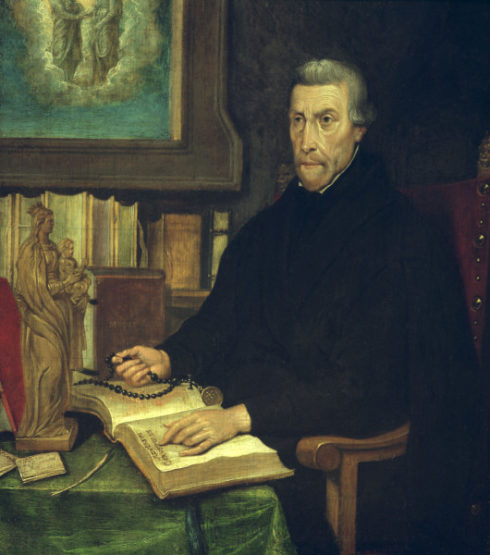
Painting by Jeroni Jacint Espinosa

Painting by Jeroni Jacint Espinosa

This saint was born in Valencia, Spain, in 1227, and descended of the ancient family of the Paschals, which had edified the Church by the triumphs of five glorious martyrs, which it produced under the Moors.

Peter’s parents were virtuous and exceedingly charitable; and St. Peter Nolasco often lodged with them in his travels. The birth of our saint was ascribed by them to his prayers and blessing, and the child received from him an early tincture of sincere piety. Peter Paschal performed his studies under domestic tutors, and, having received the tonsure, was made canon at Valencia, soon after the king of Aragon had won that city from the Moors.

St. Peter Nolasco

St. Peter Nolasco

His preceptor was a priest of Narbonne, a doctor of divinity, of the faculty of Paris, whom our saint’s parents had ransomed from the Moors, who had made him a captive. St. Peter Paschal went with him to Paris, and having studied, preached and taught with great reputation, proceeded doctor: then returned to Valencia, and, after employing a year in preparing himself, took the habit of the Order of our Lady, for the redemption of captives (Mercedarians,) in 1251. St. Peter Nolasco was his spiritual director at Barcelona, and by the instructions of that experienced master, our saint made great progress in the exercises of an interior life.

James I, king of Aragon, chose him preceptor to his son Sanchez, who embraced an ecclesiastical state, afterwards entered himself in this Order, and was soon after made archbishop of Toledo, in 1262. The prince being at that time too young to receive the episcopal consecration, St. Peter Paschal was appointed his suffragan to govern his diocese, and was ordained titular bishop of Granada: which city was at that time in the hands of the Mahometans. The prince archbishop died a martyr of the wounds he received by the Moors, who had invaded the territory of his diocese, making great havoc in his flock, in 1275.

King James I of Aragon

King James I of Aragon

St. Peter Paschal was by this accident restored to his convent; but joined the functions of the ministry with those of a contemplative and penitential life. He founded several new convents of his Order at Toledo, Baëza, Xerez, and particularly at Jaën, twenty-two miles from Granada, endeavouring by this last to procure the means of affording some spiritual succours to the afflicted Church of Granada, which he regarded as his own peculiar charge, though he was not suffered to serve it. The martyrdom of B. Peter of Chemin, a religious man of the same Order which our saint professed, and who was put to death at Tunis in 1284, kindled in his breast an ardent desire of martyrdom.

The emblem of Mercedarians (Order of Our Lady of Mercy).

The emblem of Mercedarians (Order of Our Lady of Mercy).

Being made bishop of Jaën in 1296, fearless of all dangers, he went often to Granada, and there not only ransomed the captives, and instructed and comforted the Christians, but also preached to the infidels, and reconciled to the Church several apostates, renegades, and others. On this account he was at length shut up in a dark dungeon, with a severe prohibition that no one should be allowed to speak to him. Yet he found means there to write an excellent treatise against Mohammedanism, by which several were converted. Whereat some of the infidels took great offense, and complained to the king, who gave them authority to put him to death in whatever manner they should think fit. Whilst he was at his prayers, after having said mass in his dungeon, he was murdered, receiving two stabs in his body: after which his head was struck off.

St. Peter Paschal

St. Peter Paschal

His martyrdom happened on the 6th of December, in the year of Christ 1300, of his age seventy-two. The Christians procured his chalice, sacred ornaments, and discipline, and secretly buried his body in a grotto, in a mountain near Mazzomores. Not long after, it was translated to Baëza, where it still remains. His name occurs in the Roman Martyrology on the 6th of December, and on the 23d of October.

See the memorials drawn up for his canonization, and Hist. des Ord. Relig.

Cfr. The Lives of the Saints, 1866, by Rev. Alban Butler (1711–73).  Volume XII: December. pp. 647-648

Subscription19

{ 0 comments }

Life of Saint Nicholas from Legenda Aurea by Jacobus de Voragine

Here beginneth the Life of Saint Nicholas the Bishop.

Stained glass window of St. Nicholas in Joinville, France.

Stained glass window of St. Nicholas in Joinville, France.

Nicholas is said of Nichos, which is to say victory, and of laos, people, so Nicholas is as much as to say as victory of people, that is, victory of sins, which befoul people. Or else he is said, victory of people, because he enseigned and taught much people by his doctrine to overcome vices and sins. Or Nicholas is said of Nichor, that is the resplendor or shining of the people, for he had in him things that make shining and clearness. After this Saint Ambrose saith: “The word of God, very confession, and holy thought, make a man clean.” And the doctors of Greece write his legend, and some others say that Methodius the patriarch wrote it in Greek, and John the deacon translated it into Latin and adjousted thereto many things.

Nicholas, citizen of the city of Patras, was born of rich and holy kin, and his father was Epiphanes and his mother Johane. He was begotten in the first flower of their age, and from that time forth on they lived in continence and led an heavenly life. Then the first day that he was washed and bathed, he addressed him right up in the basin, and he would not take the breast nor the pap but once on the Wednesday and once on the Friday, and in his young age he eschewed the plays and japes of other young children. He used and haunted gladly holy church; and all that he might understand of holy scripture he executed it in deed and work after his power. And when his father and mother were departed out of this life, he began to think how he might distribute his riches, and not to the praising of the world but to the honor and glory of God.

St Nicholas Giving Dowry to Three Poor Girls, Painting by Bl. Fra Angelico

St Nicholas Giving Dowry to Three Poor Girls, Painting by Bl. Fra Angelico

And it was so that one, his neighbor, had then three daughters, virgins, and he was a nobleman: but for the poverty of them together, they were constrained, and in very purpose to abandon them to the sin of lechery, so that by the gain and winning of their infamy they might be sustained. And when the holy man Nicholas knew hereof he had great horror of this villainy, and threw by night secretly into the house of the man a mass of gold wrapped in a cloth. And when the man arose in the morning, he found this mass of gold, and rendered to God therefor great thanks, and therewith he married his oldest daughter. And a little while after this holy servant of God threw in another mass of gold, which the man found, and thanked God, and purposed to wake, for to know him that so had aided him in his poverty. And after a few days Nicholas doubled the mass of gold, and cast it into the house of this man. He awoke by the sound of the gold, and followed Nicholas, which fled from him, and he said to him: “Sir, flee not away so but that I may see and know thee.” Then he ran after him more hastily, and knew that it was Nicholas; and anon he kneeled down, and would have kissed his feet, but the holy man would not, but required him not to tell nor discover this thing as long as he lived.

The Vocation of St Nicholas Painting by Bl Fra Angelico

The Vocation of St Nicholas Painting by Bl Fra Angelico

After this the bishop of Mirea died and other bishops assembled for to purvey to this church a bishop. And there was, among the others, a bishop of great authority, and all the election was in him. And when he had warned all for to be in fastings and in prayers, this bishop heard that night a voice which said to him that, at the hour of matins, he should take heed to the doors of the church, and him that should come first to the church, and have the name of Nicholas they should consecrate him bishop. And he showed this to the other bishops and admonished them for to be all in prayers; and he kept the doors. And this was a marvelous thing, for at the hour of matins, like as he had been sent from God, Nicholas arose before all other. And the bishop took him when he was come and demanded of him his name. And he, which was simple as a dove, inclined his head, and said: “I have to name Nicholas.”

Then the bishop said to him: Nicholas, servant and friend of God, for your holiness ye shall be bishop of this place.” And sith they brought him to the church, howbeit that he refused it strongly, yet they set him in the chair. And he followed, as he did before in all things, in humility and honesty of manners. He woke in prayer and made his body lean, he eschewed company of women, he was humble in receiving all things, profitable in speaking, joyous in admonishing, and cruel in correcting.

St Nicholas meeting with the messanger of the Emperor

St Nicholas meeting with the messenger of the Emperor

It is read in a chronicle that, the blessed Nicholas was at the Council of Nice; and on a day, as a ship with mariners were in perishing on the sea, they prayed and required devoutly Nicholas, servant of God, saying: “If those things that we have heard of thee said be true, prove them now.” And anon a man appeared in his likeness, and said: “Lo! see ye me not? ye called me,” and then he began to help them in their exploit of the sea, and anon the tempest ceased. And when they were come to his church, they knew him without any man to show him to them, and yet they had never seen him. And then they thanked God and him of their deliverance. And he bade them to attribute it to the mercy of God, and to their belief, and nothing to his merits.

It was so on a time that all the province of Saint Nicolas suffered great famine, in such wise that victual failed. And then this holy man heard say that certain ships laden with wheat were arrived in the haven. And anon he went thither and prayed the mariners that they would succor the perished at least with an hundred muyes of wheat of every ship. And they said: “Father we dare not, for it is meted and measured, and we must give reckoning thereof in the garners of the Emperor in Alexandria.”

And the holy man said to them: “Do this that I have said to you, and I promise, in the truth of God, that it shall not be lessed or minished when ye shall come to the garners.”

The wheat, which was requested by St. Nicholas, is being loaded into the ship.

The wheat, which was requested by St. Nicholas, is being loaded into the ship.

And when they had delivered so much out of every ship, they came into Alexandria and delivered the measure that they had received. And then they recounted the miracle to the ministers of the Emperor, and worshiped and praised strongly God and his servant Nicholas. Then this holy man distributed the wheat to every man after that he had need, in such wise that it sufficed for two years, not only for to sell, but also to sow.

And in this country the people served idols and worshiped the false image of the cursed Diana. And to the time of this holy man, many of them had some customs of the pagans, for to sacrifice to Diana under a sacred tree; but this good man made them of all the country to cease then these customs, and commanded to cut off the tree. Then the devil was angry and wroth against him, and made an oil that burned, against nature, in water, and burned stones also. And then he transformed him in the guise of a religious woman, and put him in a little boat, and encountered pilgrims that sailed in the sea towards this holy saint, and reasoned with them thus, and said: “I would fain go to this holy man, but I may not, wherefore I pray you to bear this oil into his church, and for the remembrance of me, that ye anoint the walls of the hall”; and anon he vanished away. Then they saw anon after another ship with honest persons, among whom there was one like to Nicholas, which spake to them softly: “What hath this woman said to you, and what hath she brought?” And they told to him all by order. And he said to them: “This is the evil and foul Diana; and to the end that ye know that I say truth, cast that oil into the sea.” And when they had cast it, a great fire caught it in the sea, and they saw it long burn against nature. Then they came to this holy man and said to him: “Verily thou art he that appeared to us in the sea and dost deliver us from the sea and awaits of the devil.”

St Nicholas saves the ship and sailors from being lost at sea.

St Nicholas saves the ship and sailors from being lost at sea.

And in this time certain men rebelled against the emperor; and the emperor sent against them three princes Nepotian, Ursyn, and Apollyn. And they came into the port Adriatic, for the wind, which was contrary to them; and the blessed Nicholas commanded them to dine with him, for he would keep his people from the ravin that they made. And whilst they were at dinner, the consul, corrupt by money, had commanded three innocent knights to be beheaded. And when the blessed Nicholas knew this, he prayed these three princes that they would much hastily go with him. And when they were come where they should be beheaded, he found them on their knees, and blindfold, and the righter brandished his sword over their heads. Then Saint Nicholas embraced with the love of God, set him hardily against the righter, and took the sword out of his hand, and threw it from him, and unbound the innocents, and led them with him all safe.

Read More

{ 0 comments }

saint_nicolas

Four artists, working with stories handed down, are responsible for the Santa Claus that we know today as the “spirit of generosity and love.” The other reason we have Santa Claus and not St. Nicholas is due to Protestant hatred against Catholic Saint days.

'Old Christmas', shown riding a yule goat. 1836

‘Old Christmas’, shown riding a yule goat. 1836

The transformation of St. Nicholas into Father Christmas or Father January occurred first in Germany, then in countries where the Reformed Churches were in the majority, and finally in France, the feast day being celebrated on Christmas or New Year’s Day. Dutch Protestant settlers in New Amsterdam (New York City) replaced St. Nicholas (Sinter Claes) with the benevolent magician who became known as Santa Claus.

Victorian depiction of Father Christmas.

Victorian depiction of Father Christmas.

In 1517, the Protestant Reformation took place. Protestants do not believe in Saints. However, St. Nicholas was so beloved by everyone that people held onto his memory of being generous and loving, but they did away with the Catholic influence by creating new characters based on him, like Father Christmas or Pére Noël. In the Dutch legend Sinta Claes and his original elf, Black Peter, a small Moor, leaves Spain in their rowboat on St. Nicholas day, December 6, and heads for Amsterdam. After landing on Christmas Eve with gifts, he asks parents if their children have been good or bad. If good, gifts go in their shoes; if bad, lumps of coal instead. When Dutch settlers, who were predominantly Protestant, came to New Amsterdam (New York) in the 1600’s, they brought their version of “St. Nicholas” with them. With a few modifications and through bad pronunciation of Saint Nicholas, his name was changed to Sinta Claes and Black Peter was dropped.

Saint Nicholas and Black Peter, also known as Sinta Claes.

Saint Nicholas and Black Peter, also known as Sinta Claes.

In 1820, the first of four artists, Washington Irving, a very popular writer of his day, wrote a book of political satire that talked a lot about Sinta Claes, or Santa Claus. In it, he made Sinta Claes without a donkey or a white horse and put him in a horse-drawn wagon that flew over rooftops dropping presents down the chimneys of good children. Irving’s Santa was a jolly fellow with a wide hat and baggy trousers. That Santa’s garb and means of transportation didn’t last long.

Illustration from the 1864 edition of Clement Moore’s poem A Visit from St. Nicholas.

Illustration from the 1864 edition of Clement Moore’s poem A Visit from St. Nicholas.

In 1823, the second artist, a professor by the name of Doctor Clement Clarke Moore, presented his family with a poem about Santa to amuse his grandchildren and that Santa took over. The poem was A Visit from Saint Nicholas which began, “Twas the night before Christmas….” The poem quickly became popular around the United States. Clement Moore’s poem had used the description of Santa in Washington Irving’s book but he added new details. He turned him into jolly Saint Nick, a plump, happy-go-lucky elf that could squeeze down a chimney or two, with a sleigh full of toys, eight flying reindeer and he moved his home from the Mediterranean area to the North Pole.

Santa with eight flying reindeer.

Santa with eight flying reindeer.

Santa Claus was often shown dressed in green clothes, or blue or black. When one of Clement Moore’s daughters did a calligraphy version of her father’s famous poem as a Christmas gift to her husband, inspite of her father’s words, she dressed Santa Claus in a long green coat. Santa stayed an elf until the 1860’s. That is when he got fat again. In 1882, the third artist, Thomas Nast, drew whom he thought Clement Moore was describing. It was published in a newspaper called Harper’s Weekly.

Santa Claus by Thomas Nast

Santa Claus by Thomas Nast

Thomas Nast, an illustrator for Harper’s magazine, pictured a round Santa. He also drew Santa’s map, giving Santa a North Pole workshop and home. He also made this Santa have a worldwide list of good and bad children. This version of Santa Claus lasted until the 1920s, when advertising got involved.

First Coca-Cola Santa in 1931 created by Haddon Sundblom.

First Coca-Cola Santa in 1931 created by Haddon Sundblom.

The last artist, Haddom Sundblom, worked for the Coca-Cola Company and drew its posters and advertisements. Haddom Sundblom decided that Santa wore red and was not really an elf. He also made Santa drink a Coke. This Santa Claus was made in the early thirties. The red-velvet-wearing, bigger-than-life Santa that Haddom Sundblom designed for advertising 80 years ago is how most people think of Santa Claus today.

Cover of one of the 1939 books of the Robert L. May story by Maxton Publishers, Inc.

Cover of one of the 1939 books of the Robert L. May story by Maxton Publishers, Inc.

In 1939, Santa picked up the ninth reindeer, Rudolph; that red-nosed reindeer was created by an advertising writer for Montgomery Ward.

by Jenifer Segerstrom

________________________________

Short Stories on Honor, Chivalry, and the World of Nobility—no. 554


Subscription1

{ 0 comments }

St. Ambrose

Statue of St. Ambrose in Copenhagen

Bishop of Milan from 374 to 397; born probably 340, at Trier, Arles, or Lyons; died 4 April, 397. He was one of the most illustrious Fathers and Doctors of the Church, and fitly chosen, together with St. Augustine, St. John Chrysostom, and St. Athanasius, to uphold the venerable Chair of the Prince of the Apostles in the tribune of St. Peter’s at Rome.

When St. Ambrose was an infant, a swarm of bees settled on his face while he lay in his cradle, leaving behind a drop of honey. His father considered this a sign of his future eloquence and honeyed tongue. For this reason, St. Ambrose is the patron Saint of Beekeepers.

The materials for a biography of the Saint are chiefly to be found scattered through his writings, since the “Life” written after his death by his secretary, Paulinus, at the suggestion of St. Augustine, is extremely disappointing. Ambrose was descended from an ancient Roman family, which, at an early period had embraced Christianity, and numbered among its scions both Christian martyrs and high officials of State. At the time of his birth his father, likewise named Ambrosius, was Prefect of Gallia, and as such ruled the present territories of France, Britain, and Spain, together with Tingitana in Africa. It was one of the four great prefectures of the Empire, and the highest office that could be held by a subject. Trier, Arles, and Lyons, the three principal cities of the province, contend for the honour of having given birth to the Saint. He was the youngest of three children, being preceded by a sister, Marcellina, who become a nun, and a brother Satyrus, who, upon the unexpected appointment of Ambrose to the episcopate, resigned a prefecture in order to live with him and relieve him from temporal cares. About the year 354 Ambrosius, the father, died, whereupon the family removed to Rome. The saintly and accomplished widow was greatly assisted in the religious training of her two sons by the example and admonitions of her daughter, Marcellina, who was about ten years older than Ambrose. Marcellina had already received the virginal veil from the hands of Liberius, the Roman Pontiff, and with another consecrated virgin lived in her mother’s house. From her the Saint imbibed that enthusiastic love of virginity which became his distinguishing trait. His progress in secular knowledge kept equal pace with his growth in piety. It was of extreme advantage to himself and to the Church that he acquired a thorough mastery of the Greek language and literature, the lack of which is so painfully apparent in the intellectual equipment of St. Augustine and, in the succeeding age, of the great St. Leo. In all probability the Greek Schism would not have taken place had East and West continued to converse as intimately as did St. Ambrose and St. Basil. Upon the completion of his liberal education, the Saint devoted his attention to the study and practice of the law, and soon so distinguished himself by the eloquence and ability of his pleadings at the court of the praetorian prefect, Anicius Probus, that the latter took his into his council, and later obtained for him from the Emperor Valentinian the office of consular governor of Liguria and Æmilia, with residence in Milan. “Go”, said the prefect, with unconscious prophecy, “conduct thyself not as a judge, but as bishop”. We have no means of ascertaining how long he retained the civic government of his province; we know only that his upright and gently administration gained for him the universal love and esteem of his subjects, paving the way for that sudden revolution in his life which was soon to take place. This was the more remarkable, because the province, and especially the city of Milan, was in a state of religious chaos, owing to the persistent machinations of the Arian faction.

The house of St. Ambrose in Rome.

Bishop of Milan

Ever since the heroic Bishop Dionysius, in the year 355, had been dragged in chains to his place of exile in the distant East, the ancient chair of St. Barnabas had been occupied by the intruded Cappadocian, Auxentius, an Arian filled with bitter hatred of the Catholic Faith, ignorant of the Latin language, a wily and violent persecutor of his orthodox subjects. To the great relief of the Catholics, the death of the petty tyrant in 374 ended a bondage which had lasted nearly twenty years. The bishops of the province, dreading the inevitable tumults of a popular election, begged the Emperor Valentinian to appoint a successor by imperial edict; he, however, decided that the election must take place in the usual way. It devolved upon Ambrose, therefore, to maintain order in the city at this perilous juncture. Proceeding to the basilica in which the disunited clergy and people were assembled, he began a conciliatory discourse in the interest of peace and moderation, but was interrupted by a voice (according to Paulinus, the voice of an infant) crying, “Ambrose, Bishop”. The cry was instantly repeated by the entire assembly, and Ambrose, to his surprise and dismay, was unanimously pronounced elected. Quite apart from any supernatural intervention, he was the only logical candidate, known to the Catholics as a firm believer in the Nicene Creed, unobnoxious to the Arians, as one who had kept aloof from all theological controversies. The only difficulty was that of forcing the bewildered consular to accept an office for which his previous training nowise fitted him. Strange to say, like so many other believers of that age, from a misguided reverence for the sanctity of baptism, he was still only a catechumen, and by a wise provision of the canons ineligible to the episcopate. That he was sincere in his repugnance to accepting the responsibilities of the sacred office, those only have doubted who have judged a great man by the standard of their own pettiness. Were Ambrose the worldly-minded, ambitious, and scheming individual they choose to paint him, he would have surely sought advancement in the career that lay wide open before him as a man of acknowledged ability and noble blood. It is difficult to believe that he resorted to the questionable expedients mentioned by his biographer as practised by him with a view to undermining his reputation with the populace. At any rate his efforts were unsuccessful. Valentinian, who was proud that his favourable opinion of Ambrose had been so fully ratified by the voice of clergy and people, confirmed the election and pronounced severe penalties against all who should abet him in his attempt to conceal himself. The Saint finally acquiesced, received baptism at the hands of a Catholic bishop, and eight day later, 7 December 374, the day on which East and West annually honour his memory, after the necessary preliminary degrees was consecrated bishop.

St Ambrose Stopping Theodosius from entering the Church. For his responsibility for a massacre at Thessalonika in 390, the emperor Theodosius was excommunicated by St. Ambrose until he had done public penance. The emperor is shown on the church steps surrounded by his courtiers. St. Ambrose forbids him to enter.

He was now in his thirty-fifth year, and was destined to edify the Church for the comparatively long space of twenty-three active years. From the very beginning he proved himself to be that which he has ever since remained in the estimation of the Christian world, the perfect model of a Christian bishop. There is some truth underlying the exaggerated eulogy of the chastened Theodosius, as reported by Theodoret (v, 18), “I know no bishop worthy of the name, except Ambrose”. In him the magnanimity of the Roman patrician was tempered by the meekness and charity of the Christian saint. His first act in the episcopate, imitated by many a saintly successor, was to divest himself of his worldly goods. His personal property he gave to the poor; he made over his landed possessions to the Church, making provision for the support of his beloved sister. The self-devotion of his brother, Satyrus, relieved him from the care of the temporalities, and enabled him to attend exclusively to his spiritual duties. In order to supply the lack of an early theological training, he devoted himself assiduously to the study of Scripture and the Fathers, with a marked preference for Origen and St. Basil, traces of whose influence are repeatedly met with in his works. With a genius truly Roman, he, like Cicero, Virgil, and other classical authors, contented himself with thoroughly digesting and casting into a Latin mould the best fruits of Greek thought. His studies were of an eminently practical nature; he learned that he might teach. In the exordium of his treatise, “De Officiis”, he complains that, owing to the suddenness of his transfer from the tribunal to the pulpit, he was compelled to learn and teach simultaneously. His piety, sound judgment, and genuine Catholic instinct preserved him from error, and his fame as an eloquent expounder of Catholic doctrine soon reached the ends of the earth. His power as an orator is attested not only by the repeated eulogies, but yet more by the conversion of the skilled rhetorician Augustine. His style is that of a man who is concerned with thoughts rather than words. We cannot imagine him wasting time in turning an elegant phrase. “He was one of those”, says St. Augustine, “who speak the truth, and speak it well, judiciously, pointedly, and with beauty and power of expression” (De doct. christ., iv,21).

St Ambrose accepting a repentant Theodosius

His Daily Life

Through the door of his chamber, wide open the livelong day, and crossed unannounced by all, of whatever estate, who had any sort of business with him, we catch a clear glimpse of his daily life. In the promiscuous throng of his visitors, the high official who seeks his advice upon some weighty affair of state is elbowed by some anxious questioner who wishes to have his doubts removed, or some repentant sinner who comes to make a secret confession of his offenses, certain that the Saint “would reveal his sins to none but God alone” (Paulinus, Vita, xxxix). He ate but sparingly, dining only on Saturdays and Sundays and festivals of the more celebrated martyrs. His long nocturnal vigils were spent in prayer, in attending to his vast correspondence, and in penning down the thoughts that had occurred to him during the day in his oft- interrupted readings. His indefatigable industry and methodical habits explain how so busy a man found time to compose so many valuable books. Every day, he tells us, he offered up the Holy Sacrifice for his people (pro quibus ego quotidie instauro sacrificium). Every Sunday his eloquent discourses drew immense crowds to the Basilica. One favorite topic of his was the excellence of virginity, and so successful was he in persuading maidens to adopt the religious profession that many a mother refused to permit her daughters to listen to his words. The saint was forced to refute the charge that he was depopulating the empire, by quaintly appealing to the young men as to whether any of them experienced any difficulty in finding wives. He contends, and the experience of ages sustains his contention (De Virg., vii) that the population increases in direct proportion to the esteem in which virginity is held. His sermons, as was to be expected, were intensely practical, replete with pithy rules of conduct which have remained as household words among Christians. In his method of biblical interpretation all the personages of Holy Writ, from Adam down, stand out before the people as living beings, bearing each his distinct message from God for the instruction of the present generation. He did not write his sermons, but spoke them from the abundance of his heart; and from notes taken during their delivery he compiled almost all the treatises of his that are extant.

St. Ambrose ordained as Bishop. Painting by Juan de Valdés.

Read More

{ 0 comments }

Bl. Ralph Sherwin

Bl. Ralph SherwinEnglish martyr, born 1550 at Rodesley, near Longford, Derbyshire; died at Tyburn, 1 December, 1581. In 1568 Sir William Petre nominated him to one of the eight fellowships which he had founded at Exeter College, Oxford, probably acting under the influence of the martyr’s uncle, John Woodward, who from 1556 to 1566 had been rector of Ingatestone, Essex, where Sir William lived. There Blessed Ralph took the degree of M.A., 2 July, 1574, and was accounted “an acute philosopher, and an excellent Grecian and Hebrician”. In 1575 he fled abroad and went to the English College at Douai, where 23 March, 1577, he was ordained priest by the Bishop of Cambrai. On 2 August, 1577, he left for Rome, where he stayed at the English College nearly three years, becoming leader of the movement, which placed it under the supervision of the Jesuits. On 18 April, 1580, he set out for England, a member of a party of fourteen; at Milan they were guests of St. Charles for eight days, and Blessed Ralph preached before him.

The martyrdom of St Ralph Sherwin and companions from a painting in the tribune of the English College Church.

The martyrdom of St Ralph Sherwin and companions from a painting in the tribune of the English College Church.

On 9 November, 1580, he was imprisoned in the Marshalsea, where he converted many fellow prisoners, and on 4 December was transferred to the Tower, where he was severely racked, 15 December, and afterwards laid out in the snow. The next day he was racked again, after which second torture he “lay for five days and nights without any food or speaking to anybody. All which time he lay, as he thought in a sleep, before our Saviour on the Cross. After which time he came to himself, not finding any distemper in his joints by the extremity of the torture.” After a year’s imprisonment he was brought to trial, on an absurd charge of treasonable conspiracy, in Westminster Hall 20 November, 1581, and being found guilty was taken back to the Tower, whence he was drawn to Tyburn on a hurdle shared by Blessed Alexander Briant. He suffered very bravely, his last words being, Jesu, Jesu, Jesu, esto mihi Jesus!

John B. Wainewright (Catholic Encyclopedia)

{ 0 comments }

The present Soviet-Cuban aggression against the African continent has been prepared by decades of infiltration, propaganda, and communist inspired terrorist activity. The lives of the African people have been systematically disrupted, the land has been devastated, and religious and shrines of the Church have been desecrated.

These assaults have at times, by way of reaction, providentially called forth great proofs of love of the Church and truly noble and transcendent counter-revolutionary triumphs. One of the most heroic and legendary of these, one which will continue to reverberate across the centuries, was written in blood by a grail woman in Northeastern Zaire. She is [Blessed Marie-Clémentine*] Sister Anuarita of Bafwabaka, faithful bride of Christ, who gave her life to preserve the kingdom of Christ in Africa without spot or stain.

The Reign Of Terror In Stanleyville

In November of 1964, the Simbas unleashed a reign of terror in Stanleyville, now called Kisangani (northeastern Zaire). Commissars Mulele and Gbenye terrorized the eastern province, seizing hostages and brutalizing the people.

On November 3, Gbenye declared in a radio broadcast that he still held many white hostages and would kill them without exception if the central government in Leopoldville, now Kinshasa, did not halt the advance of its troops. The situation in Stanleyville worsened daily, producing serious shortages of food and water. Looters and thieves continuously roamed the neighborhoods, violating the homes of the people. Everywhere, the enemies of the tyrants were summarily condemned to die; the death sentences were executed by forcing the victims to drink gasoline and then blowing them up alive…

The Belgians Save The Hostages

As scattered news of the reign of terror filtered to the outside world, the Belgians determined to send in 600 airborne troops. On November 24, around 6 o’clock in the morning, U.S. Air Force transport planes dropped the parachutists over Stanleyville.

Christophe Gbenye, President of the Republic People’s Republic of Congo, and General Nicholas Olenga at the Lumumba Monument in Stanleyville, summer 1964. Gbenye is standing atop of the flag of the defunct Republic of the Congo (Léopoldville).

Besides themselves with fury, the Simbas hastily pushed 250 hostages into Sergeant Kintele Avenue and made them kneel down. “If the Belgians come, you will all die,” shouted “Major” Babu, a former boxer and drug addict who commanded the rebel troops. However, as he shouted “kill them!”, the Belgians assaulted the street and nearly all the hostages were saved. This time the Simbas were defeated.

The Death Dance Continues

The withdrawal of the Simbas was terrible. Missionaries were assassinated, nuns raped, missions burned down in the jungle. In Paulis, more than 4,000 Africans were executed by firing squads. Almost everyone who knew how to read and write was tortured to death. An old missionary had all of his bones broken, one by one, by rifle stocks. Twenty women died under terrible tortures.

The Rebels Arrive In Bafwabaka

On Sunday, November 29, a rebel group commanded by “Colonel” Olombe reached the missionary outpost of Bafwabaka. There he would find a convent of nuns of African origin, the Sisters of the Holy Family, consisting of 36 nuns, novices and aspirants. The community is called “Jamaa Taratifu” in Swahili.

On that day, one of the members of the community, Sister Clementine Anuarita, was celebrating her twenty-fifth birthday. It was going to be her last…

Sister Anuarita: “The Sunshine At Your Disposal”

Sister Anuarita was baptized at the age of six, receiving the name of Alfonsine. Those who knew her in her village say that she was a joyful, vivacious, and dedicated child. They recall that in Wamba, where she attended elementary school, she had the habit of visiting the poor and the sick.

As was common among African children, she began while still quite young helping her parents at home: drawing water from the well, gathering wood, and cooking a few things on the stove. Like her companions of the same age, she feared the snakes she encountered on the way to the well, and enjoyed playing with puppies and goats in the village. She was a typical African child.

But Alfonsine Anuarita was uncommonly intelligent. Because of this, after leaving elementary school, she went to high school in Bafwabaka with the Sisters of the Holy Family. Convent life must have exerted a strong attraction over her, for in 1955 she was already an aspirant. In 1959, she made her first vows, receiving the name of Sister Clementine. She began working as a teacher, and after a complementary course in 1963, became director of the girls’ boarding school where she herself had been a student a few years earlier.

Within the community of sisters she was known as “the sunshine at your disposal.” She was always serene, joyful, and ready for whatever was necessary. After school, she went with the sisters in charge of maintenance to help them pick up wood, to fish in the NepokoRiver, and to wash and iron clothes. On many Sundays, the sisters and students were able to enjoy cake and other deserts. In the notebook of Sister Anuarita – now part of the material of her canonization process in Rome – cake and desert recipes can be found besides texts of meditation and her personal notes. To bring joy to the boarding students, she always managed to find new recipes somewhere. On that November 29, Sister Anuarita had prepared something for her twenty-fifth birthday. But everything would turn out differently…

“I’d Rather Die Than Commit Such A Sin!”

Suddenly, from the jungle came the Simbas in drab olive trucks. They stopped in front of the convent, their brakes squeaking. The rebels, most of whom were drunk or high on hashish, staggered toward the convent, shouting and waving automatic rifles, long knives, and spears in the air. At “Colonel” Olombe’s orders, they pushed the nuns into the trucks, and in a few minutes the column resumed its march. Sister Anuarita tried to assuage the fear of the other sisters with a few words.

After some miles of travel through the jungle, the vehicles halted at a Simba camp. Other trucks drove up. The Mulele soldiery launched out against the sisters, snatching their pectoral crosses from them and uttering savage and obscene insults…

Map showing the territory controlled by the Simba (red) and Kwilu (yellow) rebels, 1964. Photo by Don-kun, Uwe Dedering

Finally, they resume the painful trip through the jungle, arriving by nightfall in Isoro. “Colonel” Olombe ordered everyone out of the trucks. Approaching Sister Anuarita, he said in a hoarse voice: “Tonight you will be my woman.” Anuarita shook her head, signifying “no, never.” The furious “colonel” struck her violently and then pulled her to himself. Anuarita resisted with all her strength, shouting: “This would be a grave sin. I’d rather have you kill me!”

Held as she was by brute force, she turned to her sister: “Pray with me, help me. I’d rather die than commit such a sin!” Olombe tried to pull her into his car, but the nun defended herself with all her strength. “Let me go! I am ready to die here. I will never be your woman!”

“Death Is Swallowed Up In Victory”

The “colonel” went mad. He dealt heavy blows to her face and body with his rifle stock, causing her to fall to the ground, her face covered with blood. He knew no mercy, striking like a madman the dilacerated body inside the white habit. The voice of Sister Anuarita became weaker: “Go on beating, I have made my decision.” And then breathing forth her last sigh, she whispered: “May God forgive you, you don’t know what you do…”

The situation of the “colonel” was becoming disagreeable. He had just “finished” with a defenseless young woman and this – even in the eyes of the rebels – was not an act of heroism. Forcing a smile, he quipped: “Comrades, I killed an enemy of the Revolution. Two rebels step forward with their spears, piercing Sister Anuarita’s body three or four times. In addition, Olombe shot the dead sister in the head.

At first, Anuarita’s sisters were petrified. Then during her martyrdom, one of them began to change the “Magnificat.” Trembling, and with tears in their eyes, the other joined her: “…and my spirit hath rejoiced in God my Saviour.”

The rebels, disconcerted and speechless, ran away in a desperate flight. “Sister Anuarita has protected us,” one of the nuns exclaimed. “The martyrs of Uganda and Saint Mary Goretti have always been her models. Now she has followed both of them,” they wrote on November 30, 1964, the eve of All Saints’ Day.

If the Church in eastern Zaire is able to celebrate its hundredth jubilee in 1980, Africa will have a new Saint. The missionary Bishop of Catarzi Uvira (in the South of the Kivu province) affirmed: “Sister Anuarita will be for us a powerful intercessor with God, so that He may help us to finally attain peace in this country.”

Taken from Crusade For A Christian Civilization, #2, 1980, pgs. 25-27.

*She was beatified on August 15, 1985 by Pope John Paul II during his visit to Africa. She was the first Bantu woman elevated to the altars. Her memorial is 1 December.


{ 0 comments }

Our Lady of Joy

(aka Notre Dame de Liesse, or Causa Nostrae Laetitiae)

Our Lady of Liesse

Our Lady of Liesse

In 1134 three Knights of the Order of Saint John of Jerusalem, prisoners of the Muslims in Egypt, miraculously found or received in their prison a statue of Our Lady, which they named Our Lady of Joy, or Notre Dame de Liesse.

Painting of the Basilica of Notre Dame de Liesse where the Image of Our Lady of Liesse is enthroned.

Painting of the Basilica of Notre Dame de Liesse where the Image of Our Lady of Liesse is enthroned.

In response to their prayers, a young Muslim princess named Ismerie took an interest in the Knights, and through the intercession of Our Lady and the mercy of God, the princess was converted. The princess arranged the escape of the pious crusaders and joined them on their journey to France. They carried the statue with them, and in the region of Laon, about 35 miles northwest of Reims, they founded a church as a resting place for the statue.

In June 1686, St. John Baptist de la Salle and twelve Brothers went to the shrine of Our Lady of Liesse to renew their vow of obedience. Painting by Giovanni Gagliardi, 1901

In June 1686, St. John Baptist de la Salle and twelve Brothers went to the shrine of Our Lady of Liesse to renew their vow of obedience. Painting by Giovanni Gagliardi, 1901

Through local devotion the church took on the name of the statue, and gave that name to the whole region, so that Notre Dame de Liesse came to refer to both the devotion and the place. The statue came to be venerated by many, and Notre Dame de Liesse became the Patroness of the Diocese of Soissons.

In 1620 the titular Bailiff of Armenia, Fra’ Jacques Chenu de Bellay, built a church to Our Lady of Liesse at Valletta in Malta. It is today the chaplaincy church of the Port of Valetta.

Notre-Dame de Liesse Statue

The original statue was destroyed during the French Revolution, but the medieval basilica at Liesse remained a center of devotion to the Mother of God, and a new statue was installed and crowned there in 1857. It is still the focus of pilgrimage, especially on Whit Monday.

Memorial in the Missal of the Sovereign Military Hospitaller Order of Saint John of Jerusalem, of Rhodes and of Malta

{ 0 comments }

General Baron Athanase Charles Marie de Charette de la Contrie 1832 -1911

The battle of Loigny, one of the most bloody encounters of that terrible winter, was made memorable by the heroic attitude of the Pontifical Zouaves, commanded by Charette, who was himself under the orders of General de Sonis, an eminent leader and a fervent Catholic. After the battle, Abbé Theuré’s house was filled with wounded soldiers, whose sufferings were increased by the bitter cold, for during the night snow had fallen heavily on the frozen ground.

Battle of Loigny-Poupry. Painting by Charles Castellani

Early on December 3d, General de Sonis, who had spent the night on the frozen ground, was carried into the presbytery. Abbé Theuré never forgot the sight, “I seem to see him now,” he used to say, “pale as death, his face and clothes covered with snow and frost. With much difficulty he was undressed and laid on a bed in my room.” One of his legs was frozen, the other so grievously wounded that on December 4th it became necessary to amputate it. Sonis only remarked when informed that the operation was necessary: “God’s will be done. Doctor do what is necessary only leave me leg enough to ride and serve my country.” The Curé assisted at the operation, during which the general, who had been given an anesthetic, prayed aloud or gave orders to his men.

General de Sonis and many other soldiers lay on the battlefield. He survived but had his leg amputated. (Painting by Eugène Lelièpvre)

A strong friendship sprang up between the general and the priest, whom Sonis used to call “my good Samaritan” and among the horrors of those days of nursing the Abbé Theuré learnt, with patriotic pride, how the Papal Zouaves had honored the banner of the Sacred Heart during the battle. This banner, embroidered by the Visitation Nuns of Paray-le-Monial, was given to the Zouaves; it was displayed in front of the army at a critical moment. General de Sonis, perceiving that some of his men belonging to the regular army, were loth to march forward, appealed to the Papal Zouaves to lead the advance, and to encourage the wavering troops. He picked out three hundred among them to follow him; out of these 198 were killed, and ten officers out of fourteen were mortally wounded.

The banner, embroidered by the Visitation Nuns of Paray le Monial and given to General de Sonis.

The banner of the Sacred Heart was entrusted to M. de Verthamon; then, when he fell, to the two Bouilles, father and son, and when these, too, were grievously wounded, to a Zouave named Parmentier, who saved it from falling into the enemy’s hands. The wounded bearers of the banner, the Bouilles and young Verthamon, were, like their general, carried to the presbytery of Loigny, where as soon as Madame de Sonis discovered her husband’s whereabouts she hastened to rejoin him. The Curé worked day and night among his wounded guests; their misery was great, but owing to his initiative provisions were sent to Loigny by some charitable persons at Chartres. “The devotedness of this priest is beyond all praise,” wrote General de Sonis. “Day and night he is in the ambulances. He gives all that he possesses, he gives himself. He saves our bodies and our souls, we only exist owing to the alms that be procured for us.” To the general’s great joy, the good Curé said Mass in his room on the feast of the Immaculate Conception.

Photograph of the vicar of Loigny-la-Bataille, Father Theuré, who collected various objects from the battlefield and formed the Musée de la Guerre 1870 Loigny-la-Bataille.

“The Curé’s devotedness is incomparable,” wrote Madame de Sonis, who during three months, slept on the ground close to her husband’s sick couch. The memory of the battle of Loigny and of the scenes of horror and heroism, in which he had played a part, never left the Abbé Theuré. After the war was over, he set to work to rebuild the village and its church, and conceived the happy idea of making the new edifice a memorial church, where the bones of the heroic dead should rest in the shadow of God’s sanctuary. General de Sonis, who died the death of a saint, on August 15th, 1887, was on September 22d, brought to Loigny, and Abbé Theuré presided at the ceremony. Upon the general’s coffin lay his sword, his decorations and the bloodstained banner of the Sacred Heart, and close by knelt the dead soldier’s eight children, four of his sons wearing the military uniform. Upon the tomb, by the general’s own wish, the following short inscription was engraved: Die XXII Sept., 1887in spem vitæ—hic depositus est—et requiescit—Miles Christi Gaston de Sonis—General de division né le 27 Aout, 1825—décédé le 15 Aout, 1887—Priez pour lui.

The Church Saint-Lucain à Loigny-la-Bataille. Photo by Bertrand Chabin. Rebuilt on the sight to replace the one destroyed during the battles of Loigny-la-Bataille, December 2, 1870. The walls of the apse and the vault are decorated with paintings with historical and religious motifs, and covered with commemorative marble plaques bearing the names of the 700 recognized soldiers. The crypt preserves the tombs of the Generals of Sonis and Charette, as well as the bones of 1,300 soldiers.

A little more than a year ago, General de Charette’s body was laid in the crypt of Loigny by the side of his brother in arms; now the devoted priest, the friend of both, has, in his turn, gone to receive his reward, and his mortal remains have been brought to rest in the church that owes its existence to his zeal. He never sought notice or honor, and when the war was over he quietly resumed his labors as a country priest. But his name had become a household word among his countrymen. The Pope bestowed upon him the title of Monsignor, and the dignity of apostolic protonotary, and the anti clerical Government of France, for once, recognized the services of a priest and gave this true patriot the cross of the Legion of Honor. On January 15th, the Abbé Theuré’s mortal remains were buried, with due honor, in the crypt of Loigny, where he sleeps his last sleep close to his friends, Sonis and Charette.

FEBRUARY 8, 1913, No 18, pg. 419 AMERICA, A Catholic Review of the Week VOL VIII, By The American Press

Short Stories on Honor, Chivalry, and the World of Nobility—no. 703

{ 0 comments }

St. Francis Xavier

Born in the Castle of Xavier near Sanguesa, in Navarre, 7 April, 1506; died on the Island of Sancian near the coast of China, 2 December, 1552.

In 1525, having completed a preliminary course of studies in his own country, Francis Xavier went to Paris, where he entered the collège de Sainte-Barbe. Here he met the Savoyard, Pierre Favre, and a warm personal friendship sprang up between them. It was at this same college that St. Ignatius Loyola, who was already planning the foundation of the Society of Jesus, resided for a time as a guest in 1529. He soon won the confidence of the two young men; first Favre and later Xavier offered themselves with him in the formation of the Society. Four others, Lainez, Salmerón, Rodríguez, and Bobadilla, having joined them, the seven made the famous vow of Montmartre, 15 Aug., 1534.

Castillo de Javier, in the province of Navarra, España. The castle of the Xavier family was later acquired by the Company of Jesus.

After completing his studies in Paris and filling the post of teacher there for some time, Xavier left the city with his companions 15 November, 1536, and turned his steps to Venice, where he displayed zeal and charity in attending the sick in the hospitals. On 24 June, 1537, he received Holy orders with St. Ignatius. The following year he went to Rome, and after doing apostolic work there for some months, during the spring of 1539 he took part in the conferences which St. Ignatius held with his companions to prepare for the definitive foundation of the Society of Jesus. The order was approved verbally 3 September, and before the written approbation was secured, which was not until a year later, Xavier was appointed , at the earnest solicitation of the John III, King of Portugal, to evangelize the people of the East Indies. He left Rome 16 March, 1540, and reached Lisbon about June. Here he remained nine months, giving many admirable examples of apostolic zeal.

St. Francisco Xavier asking King John III of Portugal for an expedition.

On 7 April, 1541, he embarked in a sailing vessel for India, and after a tedious and dangerous voyage landed at Goa, 6 May, 1542. The first five months he spent in preaching and ministering to the sick in the hospitals. He would go through the streets ringing a little bell and inviting the children to hear the word of God. When he had gathered a number, he would take them to a certain church and would there explain the catechism to them. About October, 1542, he started for the pearl fisheries of the extreme southern coast of the peninsula, desirous of restoring Christanity which, although introduced years before, had almost disappeared on account of the lack of priests. He devoted almost three years to the work of preaching to the people of Western India, converting many, and reaching in his journeys even the Island of Ceylon. Many were the difficulties and hardships which Xavier had to encounter at this time, sometimes on account of the cruel persecutions which some of the petty kings of the country carried on against the neophytes, and again because the Portuguese soldiers, far from seconding the work of the saint, retarded it by their bad example and vicious habits.

St. Francis Xavier baptizing the Paravars in Goa, India.

In the spring of 1545 Xavier started for Malacca. He laboured there for the last months of that year, and although he reaped an abundant spiritual harvest, he was not able to root out certain abuses, and was conscious that many sinners had resisted his efforts to bring them back to God. About January, 1546, Xavier left Malacca and went to Molucca Islands, where the Portuguese had some settlements, and for a year and a half he preached the Gospel to the inhabitants of Amboyna, Ternate, Baranura, and other lesser islands which it has been difficult to identify. It is claimed by some that during this expedition he landed on the island of Mindanao, and for this reason St. Francis Xavier has been called the first Apostle of the Philippines. But although this statement is made by some writers of the seventeenth century, and in the Bull of canonization issued in 1623, it is said that he preached the Gospel in Mindanao, up to the present time it has not been proved absolutely that St. Francis Xavier ever landed in the Philippines.

By July, 1547, he was again in Malacca. Here he met a Japanese called Anger (Han-Sir), from whom he obtained much information about Japan. His zeal was at once aroused by the idea of introducing Christianity into Japan, but for the time being the affairs of the Society demanded his presence at Goa, whither he went, taking Anger with him. During the six years that Xavier had been working among the infidels, other Jesuit missionaries had arrived at Goa, sent from Europe by St. Ignatius; moreover some who had been born in the country had been received into the Society. In 1548 Xavier sent these missionaries to the principal centres of India, where he had established missions, so that the work might be preserved and continued. He also established a novitiate and house of studies, and having received into the Society Father Cosme de Torres, a Spanish priest whom he had met in the Maluccas, he started with him and Brother Juan Fernandez for Japan towards the end of June, 1549. The Japanese Anger, who had been baptized at Goa and given the name of Pablo de Santa Fe, accompanied them.

Saint Francis Xavier baptizing the Queen of Mexico. Painting by Giuseppe Laudati

They landed at the city of Kagoshima in Japan, 15 Aug., 1549. The entire first year was devoted to learning the Japanese language and translating into Japanese, with the help of Pablo de Santa Fe, the principal articles of faith and short treatises which were to be employed in preaching and catechizing. When he was able to express himself, Xavier began preaching and made some converts, but these aroused the ill will of the bonzes, who had him banished from the city. Leaving Kagoshima about August, 1550, he penetrated to the center of Japan, and preached the Gospel in some of the cities of southern Japan. Towards the end of that year he reached Meaco, then the principal city of Japan, but he was unable to make any headway here because of the dissensions the rending the country. He retraced his steps to the center of Japan, and during 1551 preached in some important cities, forming the nucleus of several Christian communities, which in time increased with extraordinary rapidity.

After working about two years and a half in Japan he left this mission in charge of Father Cosme de Torres and Brother Juan Fernandez, and returned to Goa, arriving there at the beginning of 1552. Here domestic troubles awaited him. Certain disagreements between the superior who had been left in charge of the missions, and the rector of the college, had to be adjusted. This, however, being arranged, Xavier turned his thoughts to China, and began to plan an expedition there. During his stay in Japan he had heard much of the Celestial Empire, and though he probably had not formed a proper estimate of his extent and greatness, he nevertheless understood how wide a field it afforded for the spread of the light of the Gospel. With the help of friends he arranged a commission or embassy the Sovereign of China, obtained from the Viceroy of India the appointment of ambassador, and in April, 1552, he left Goa. At Malacca the party encountered difficulties because the influential Portuguese disapproved of the expedition, but Xavier knew how to overcome this opposition, and in the autumn he arrived in a Portuguese vessel at the small island of Sancian near the coast of China. While planning the best means for reaching the mainland, he was taken ill, and as the movement of the vessel seemed to aggravate his condition, he was removed to the land, where a rude hut had been built to shelter him. In these wretched surroundings he breathed his last.

Painting of “Transposition of Saint Francis Xavier” in St Sulpice church. Painted by Jacques-Emile Lafon in 1859.

It is truly a matter of wonder that one man in the short space of ten years (6 May, 1542 – 2 December, 1552) could have visited so many countries, traversed so many seas, preached the Gospel to so many nations, and converted so many infidels. The incomparable apostolic zeal which animated him, and the stupendous miracles which God wrought through him, explain this marvel, which has no equal elsewhere. The list of the principal miracles may be found in the Bull of canonization. St. Francis Xavier is considered the greatest missionary since the time of the Apostles, and the zeal he displayed, the wonderful miracles he performed, and the great number of souls he brought to the light of true Faith, entitle him to this distinction. He was canonized with St. Ignatius in 1622, although on account of the death of Gregory XV, the Bull of canonization was not published until the following year.

The incorrupt body of Saint Francis Xavier, in Goa, India.

The body of the saint is still enshrined at Goa in the church which formerly belonged to the Society. In 1614 by order of Claudius Acquaviva, General of the Society of Jesus, the right arm was severed at the elbow and conveyed to Rome, where the present altar was erected to receive it in the church of the Gesu.

ANTONIO ASTRAIN (Catholic Encyclopedia)

{ 0 comments }

Clovis

ClovisSon of Childeric, King of the Salic Franks; born in the year 466; died at Paris, 27 November, 511. He succeeded his father as the King of the Franks of Tournai in 481. His kingdom was probably one of the States that sprang from the division of Clodion’s monarchy like those of Cambrai, Tongres and Cologne. Although a Pagan, Childeric had kept up friendly relations with the bishops of Gaul, and when Clovis ascended the throne he received a most cordial letter of congratulation from St. Remigius, Archbishop of Reims. The young king early began his course of conquest by attacking Syagrius, son of Aegidius, the Roman Count. Having established himself at Soissons, he acquired sovereign authority over so great a part of Northern Gaul as to be known to his contemporaries as the King of Soissons. Syagrius, being defeated, fled for protection to Alaric II, King of the Visigoths, but the latter, alarmed by a summons from Clovis, delivered Syagrius to his conqueror, who had him decapitated in 486. Clovis then remained master of the dominions of Syagrius and took up his residence at Soissons. It would seem as if the episode of the celebrated vase of Soissons were an incident of the campaign against Syagrius, and it proves that, although a pagan, Clovis continued his father’s policy by remaining on amicable terms with Gaulish episcopate. The vase, taken by the Frankish soldiers while plundering a church, formed part of the booty that was to be divided among the army. It was claimed by the bishop (St. Remigius?), and the king sought to have it awarded to himself in order to return it intact to the bishop, but a dissatisfied soldier split the vase with his battle-axe, saying to this king: “You will get only the share allotted you by fate”. Clovis did not openly resent the insult, but the following year, when reviewing his army he came upon this same soldier and, reproving him for the the defective condition of his arms, he split his skull with an axe, saying: “It was thus that you treated the Soissons vase.” This incident has often been cited to show that although in time of war a king has unlimited authority over his army, after the war his power is restricted and that in the division of booty the rights of the soldiers must be respected.

Battle between Clovis and the Visigoths

Battle between Clovis and the Visigoths

After the defeat of Syagrius, Clovis extended his dominion as far as the Loire. It was owing to the assistance given him by the Gaulish episcopate that he gained possession of the country. The bishops, it is quite certain mapped out the regime that afterwards prevailed. Unlike that adopted in other barbarian kingdoms founded upon the ruins of the Roman Empire, this regime established absolute equality between the Gallo-Roman natives and their Germanic conquerors all sharing the same privileges. Procopius, a Byzantine writer has given us an idea of this agreement, but we know it best by its results. There was no distribution of Gaulish territory by the victors; established in the Belgian provinces, they had lands there to which they returned after each campaign. All the free men in the kingdom of Clovis, whether they were of Roman or of Germanic origin, called themselves Franks, and we must guard against the old mistake of looking upon the Franks after Clovis as no more than Germanic barbarians.

The Education of the Children of Clovis, Painting by Lawrence Alma-Tadema

The Education of the Children of Clovis, Painting by Lawrence Alma-Tadema

Master of half of Gaul, Clovis returned to Belgium and conquered the two Salic kingdoms of Cambrai and Tongres (?), where his cousins Ragnacaire and Chararic reigned. These events have been made known to us only through the poetic tradition of the Franks which has singularly distorted them. According to this tradition Clovis called upon Chararic to assist him its his war against Syagrius, but Chararic’s attitude throughout the battle was most suspicious, as he refrained from taking sides until he saw which of the rivals was to be victorious. Clovis longed to have revenge. Through a ruse he obtained possession of Chararic and his son and threw them into prison; he then had their heads shaved, and both were ordained, the father to the priesthood and the son to the diaconate. When Chararic bemoaned and wept over this humiliation his son exclaimed: “The leaves of a green tree have been cut but they will quickly bud forth again; may he who has done this perish as quickly!” This remark was reported to Clovis, and he had both father and son beheaded.

Painting of Clovis by François-Louis Dejuinne

Painting of Clovis by François-Louis Dejuinne

Tradition goes on to say that Ragnacaire King of Cambrai, was a man of such loose morals he hardly respected his own kindred, and Farron, his favourite, was equally licentious. So great was the king’s infatuation for this man that, if given a present, he would accept it for himself and his Farron. This filled his subjects with indignation and Clovis, to win them over to his side before taking the field, distributed among them money, bracelets, and baldries, all in gilded copper in fraudulent imitation of genuine gold. On different occasions Ragnacaire sent out spies to ascertain the strength of Clovis’s army, and upon returning they said: “It is a great reinforcement for you and your Farron.” Meanwhile Clovis advanced and the battle began. Being defeated, Ragnacaire sought refuge in flight, but was overtaken; made prisoner, and brought to Clovis, his hands bound behind him. “Why”, said his conqueror have you permitted our blood to be humiliated by allowing yourself to be put in chains? It were better that you should die.” And, so saying, Clovis dealt him his death-blow. Then, turning to Richaire, Ragnacaire’s brother, who had been taken prisoner with the king, he said: “Had you but helped your brother, they would not have bound him”, and he slew Richaire also. After these deaths the traitors discovered that they had been given counterfeit gold and complained of it to Clovis, but he only laughed at them. Rignomir, one of Ragnacaire’s brothers, was put to death at Le Mans by order of Clovis, who took possession of the kingdom and the treasure of his victims.

A page from the Bedford Book of Hours (c. 1423), illustrating the legend of King Clovis receiving the fleurs-de-lis.

A page from the Bedford Book of Hours (c. 1423), illustrating the legend of King Clovis receiving the fleurs-de-lis.

Such is the legend of Clovis; it abounds in all kinds of improbabilities, which cannot be considered as true history. The only facts that can be accepted are that Clovis made war upon Kings Ragnacaire and Chararic, put them to death and seized their territories. Moreover, the author of this article is of opinion that these events occurred shortly after the conquest of the territory of Syagrius, and not after the war against the Visigoths, as has been maintained by Gregory of Tours, whose only authority is an oral tradition, and whose chronology in this matter is decidedly misleading. Besides Gregory of Tours has not given us the name of Chararic’s kingdom; it was long believed to have been established at Therouanne but it is more probable that Tongres was its capital city, since it was here that the Franks settled on gaining a foothold in Belgium.

Baptism of Clovis

Baptism of Clovis

In 492 or 493 Clovis, who was master of Gaul from the Loire to the frontiers of the Rhenish Kingdom of Cologne, married Clotilda, the niece of Gondebad, King of the Burgundians. The popular epic of the Franks has transformed the story of this marriage into a veritable nuptial poem the analysis of which will be found in the article on Clotilda. Clotilda, who was a Catholic, and very pious, won the consent of Clovis to the baptism of their son, and then urged that he himself embrace the Catholic Faith. He deliberated for a long time. Finally, during a battle against the Alemanni–which without apparent reason has been called the battle of Tolbiac (Zulpich)–seeing his troops on the point of yielding, he invoked the aid of Clotilda’s God, promised to become a Christian if only victory should be granted him. He conquered and, true to his word was baptized at Reims by St. Remigius, bishop of that city, his sister Albofledis and three thousand of his warriors at the same time embracing Christianity. Gregory of Tours, in his ecclesiastical history of the Franks has described this event, which took place amid great pomp at Christmas, 496. “Bow thy head, O Sicambrian”, said St. Remigius to the royal convert “Adore what thou hast burned and burn what thou hast adored.” According to a ninth-century legend found in the life of St. Remigius, written by the celebrated Hinemar himself Archbishop of Reims, the chrism for the baptismal ceremony was missing and was brought from heaven in a vase (ampulla) borne by a dove. This is what is known as the Sainte Ampoule of Reims, preserved in the treasury of the cathedral of that city and used for the coronation of the kings of France from Philip Augustus down to Charles X.

Read More

{ 0 comments }

St. Maximus, Bishop of Riez, Confessor

About the Year 460.

st-maximus-bishopST. MAXIMUS was born in Provence at Decomer, now called Chateau-Redon, near Digne. His truly Christian parents saw him baptized in his infancy, and brought him up in the love and practice of virtue, and an enemy to its bane, the pleasure of the senses, which the saint from his childhood made it his study to subdue and often mortify, so that in his youth he was an excellent example of profound humility, and an absolute conquest of his passions; and his virtue increased with his years. He was well made, and by the sweetness of his temper, and the overflowings of a generous heart, engaged the esteem of all who knew him; but was aware of the dangerous snare of being betrayed into a love of company and the world; and, leading a very retired life in his father’s house, gave himself up to prayer, reading, and serious studies, in which he gave early displays of genius. His mind and heart were so engaged by heavenly things that he trampled on all worldly advantages, and made a resolution of observing a perpetual continence.

Thus he remained some years in the world without living by its maxims, or seeming to belong to it; and, though among his friends, and in his own country, had no more relish for his situation than if he had been in exile, and surrounded by strangers. At last he broke the chain which seemed to fix him to the world, and, distributing his fortune among the poor, retired to the monastery of Lerins, where he was kindly received by St. Honoratus. When that holy founder was made archbishop of Arles, in 426, Maximus was chosen the second abbot of Lerins.

Église Notre-Dame de l'Assomption de Riez. Interior of Riez Cathedral.

Église Notre-Dame de l’Assomption de Riez. Interior of Riez Cathedral.

St. Sidonius assures us [1] that the monastery of Lerins seemed to acquire a new lustre by his prudent conduct and bright example, under which the monks scarcely felt the severities of the rule, so great was the cheerfulness and alacrity with which they obeyed him. The gift of miracles with which he was favoured, and the great reputation of his sanctity drew great crowds to his monastery from the continent, which, breaking in upon his retirement, obliged him to quit the house, and conceal himself some days in a forest in the island: though we are assured that the chief reason why he thus lay hid in a very rainy season was, that the clergy and people of Frejus had demanded him for bishop. After this danger was over he again made his appearance at Lerins.

Church and monastery of the Lérins Abbey, on the island of Saint-Honorat, one of the Lérins Islands, close to Cannes, France. Photo by Afernand74

Church and monastery of the Lérins Abbey, on the island of Saint-Honorat, one of the Lérins Islands, close to Cannes, France. Photo by Afernand74

It happened, however, not long after, when he had governed the abbey of Lerins about seven years, that the see of Riez in Provence became vacant about the year 433, and he was compelled to fill it: for though he had fled to the coast of Italy to shun that dignity, he was pursued and brought back. His parents being originally of that city, the saint was looked upon there as a citizen, and, on account of his sanctity, received as an angel from heaven. [2] In this dignity he continued to wear his hair shirt and habit, and to observe the monastic rule as far as was compatible with his functions: he still retained the same love of poverty, the same spirit of penance and prayer, the same indifference to the world, and the same humility, for which he had been so conspicuous in the cloister. But his patience and his charity found more employment, he being by his office the physician, pastor, and teacher, of a numerous people, and charged with the conduct of their souls to lead them to eternal life.

Among the sermons which pass under the name of Eusebius Emisenus, three or four are ascribed to St. Maximus, [3] and the first among those of Faustus of Riez. [4] He assisted at the council of Riez in 439, the first of Orange in 441, that of Arles in 454, and died on the 27th of November before the year 462. His body lies now in the cathedral of Riez, which bears jointly the names of the Blessed Virgin and St. Maximus. [5]

Subscription20

_____________________

See his life written by Dynamius, a patrician in Gaul, some time governor of Provence, and receiver of the rents of the Roman see in Gaul, as appears from St. Greg. l. 3, ep. 33. This work he dedicated to Umbricus, Faustus’s successor in the see of Riez, who died a hermit in 601. See Tillemont, t. 15; Fabricius, Bibl. Mediæ et infimæ Latinit. l. 5, vol. 2, p. 209; Rivet, Hist. Littér. t. 2, p. 357. See also the homily of this saint’s successor. Faustus, bishop of Riez, in his eulogium, published in Latin and French by Dom d’Attichi, in 1644.

Note 1. Carm. 6. v. 113.
Note 2. Faustus of Riez succeeded St. Maximus first in the abbacy of Lerins, afterwards in the episcopacy of Riez, and died about the year 493. His name and works are well known for his vigorous defence of Semipelagianism, which was not condemned by any definition of the church before the second council of Orleans, in 529. See his life in Ceillier, t. 14, p. 157–189; and principally in Rivet, Hist. Lit. t. 2, p. 585–619.
Note 3. Cave, Hist. Liter, t. 1, p. 422.
Note 4. Rivet, Hist. Littér. t. 2, p. 360.
Note 5. St. Maximus, patron of the diocess of Boulogne in Picardy, is called Masse by the common people at Boulogne, and Mans at Abbeville in Picardy. In the diocesses of Boulogne, St. Omer, and Ypres, he is singularly honoured, but confounded by mistake with St. Maximus of Riez.

(cfr. The Lives of the Saints, by Rev. Alban Butler (1711–73).  Volume XI: November, pp. 569-570)

{ 0 comments }

Count Louis de Baude Frontenac

A governor of New France, born at Paris, 1662; died at Quebec, 28 Nov., 1698.

Statue of Frontenac at the National Assembly of Québec.

Statue of Frontenac at the National Assembly of Québec.

His father was captain of the royal castle of St-Germain-en-laye; his mother, née Phelypeaux, was the daughter of the king’s secretary of state; Louis XIII was his godfather. By his valour and skill he won the rank of marshall of the king’s camps and armies. He served in Holland, France, Italy and Germany, and also in Candia where Turenne had sent him to command a contingent against the Turks. A brilliant military reputation, therefore, preceeded him to Canada. During his first administration (1672-1682) he built a fort at Cataracouy (now Kingston) to awe the Iroquois and facilitate communications with the West. To explore the course of the Mississippi, previously discovered by Joliet and Marquette, he sent Cavelier de La Salle, who named the country watered by that river Louisiana, in honour of Louis XIV. Although intelligent and magnanimous, brave and unflinching in peril, he was proud, imperious, and ready to sacrifice all to personal animosity. He quarrelled with most of the officials of the colony over petty questions: with his councillors, with the intendant (Duchesneau), with the Governor of Montreal (Perrot), and with Mgr de Laval, whose prohibition of the liquor-traffic with the Indians he judged harmful to commercial interests. The king, after vainly trying to curb his haughtiness, recalled him in 1682.
Frontenac receiving the envoy of Sir William Phipps demanding the surrender of Quebec, 1690

Frontenac receiving the envoy of Sir William Phipps demanding the surrender of Quebec, 1690

In 1689, when the uprising of the Iroquois and the Lachine massacre, in retaliation of Governor Denonville’s treacherous dealing, threatened the existence of the colony, Frontenac was sent to the rescue and was hailed as a deliverer. He had to fight the allied Iroquois and English; but his bravery and ability were equal to the task. After d’Iberville’s brilliant exploits in Hudson Bay, Frontenac divided his forces into three corps, which captured Corlar (Schenectady), Salmon Falls (N.H.) and Casco (Me.). When, to avenge these disasters, Boston sent a fleet against Quebec (1690), Frontenac’s response to the summons of Phipps’s envoy was: “Go tell your master that we shall answer him by the mouths of our guns” – a threat which was made good by the enemy’s defeat. In 1696 Frontenac wisely disregarded the instructions of France to evacuate the upper country, which would have ruined the colony, and merely observed a defensive attitude. He dealt the Iroquois power a severe blow, burned the villages of the Onnontagués and Onneyouts, and devastated their country. By his orders d’Iberville razed Fort Pemquid in Acadia, captured St. John’s, Newfoundland, and nearly the entire island, and took possession of all Hudson Bay Territory. Frontenac died sincerely regretted by the whole colony which he had saved from ruin. His character was a mixture of good and bad qualities. The latter were less evident during his second administration and his talents rendered eminent services. He found Canada weakened and attacked on all sides; he left it in peace, enlarged, and respected. He has been justly called “saver of the country”. In spite of his Jansenistic educataion and prejudices against the bishop, the Jesuits, and even the Sulpicians, he possessed a rich fund of faith and piety. He was a faithful friend of the Recollects, and was buried in their church.

HOPKINS, “Canada, An Encyclopedia of the Country” (Toronto, 1890); GARNEAU, “Histoire du Canada”(Montreal, 1882); FERLAND, “Cours d’histoire du Canada” (Quebec, 1882); ROCHEMONTEIX, “Les Jésuites et la Nouvelle-France” (Paris, 1896); CHAPAIS, “Jean Talon” (Quebec, 1904); GAUTHIER, “Histoire du Canada” (Quebec, 1876).

LIONEL LINDSAY (Catholic Encyclopedia)

{ 0 comments }

Lessons in Psychological Warfare from the Siege of Jasna Góra, November 28-December 27, 1655

This account of the siege of  Częstochowa is based on the Memoirs of the Siege of Czestochowa by Father Augustine Kordecki (Pamietnik oblezenia Częstochowy, edited and with a preface by Jan Tokarski, London, Veritas, 1956.) Written by Friar Kordecki in response to a wish of King Casimir, these memoirs were originally published in Latin in 1658. The analysis and subtitles are by Prof. Plinio Correa de Oliveira.

Jasna Góra

Jasna Góra

“When God the most High decided to chastise the Poles, in His goodness He first sent various signs warning of the catastrophe which approached.”

So He permitted that, the 10th of February 1654, the high tower of the Sanctuary of Czestochowa be struck by lighting and consumed by fire.

In that same year, on the 9th of July, everyone saw a miracle which occurred in the face of the sun: “In the nose of the sun there appeared a cross, which gradually became transformed into a heart, this latter pierced by a sword moved to one side and halted at the position of an eye. In the place of the other eye, one saw a hand holding a mace, which moved toward the forehead, dividing into four parts, and then on reaching the rim of the solar disk, became a scourge”(pg. 97).

“The following year God’s scourge against the Poles, Charles X Gustav, king of the Swedes, set out from the north.”

This king was one of the most outstanding generals of his time and one of the most ferocious of the Protestant leaders.

Carl X Gustav, King of Sweden Painting by Abraham Wuchters

Carl X Gustav, King of Sweden Painting by Abraham Wuchters

I. THE SIEGE: PHASE BEFORE THE ATTACK
THE EMPLOYMENT OF THE FEAR—
SYMPATHY BINOMIAL PREDOMINATES
The Swedes easily took the whole country, almost without resistance. Practically all the nobility, part of which was Calvinist, accepted Charles X Gustav as “Protector of the Polish Crown,” abandoning King John II Casmir to his own fate. After conquering Krakow in the far south, they sent, on orders of the Swedish King, an army of three or four thousand men to take the fortress – sanctuary of Czestochowa, about 125 miles from there.

1. A “third force Catholic”* uses the fear-sympathy binomial for the first time
Going ahead of the enemy, Count Jan Wejchard of Wrzeszczewicz, in order to gain the good graces of the king of the heretics, demands of the Pauline Friars that they hand over the fortress of Jasna Gora to him, a Catholic, to avoid its falling directly into the hands of the Swedes. He threatened to take the sanctuary by force, if the did not heed his demand. The monks headed by their Friar Augustine Kordecki tried to dissuade the count from his vile pretension and refused his proposal.

Portrait of King John II Casimir in a chainmail.

Portrait of King John II Casimir in a chainmail.

2. An authentic Catholic reacts
Meanwhile, some nobles, fleeing before the Swedish advance, sought refuge in Jasna Gora. One of them, Stephan Zamoyski, counseled the religious not to give in to the enemy, and affirmed that those who sought refuge there were prepared to die in defense of the holy place, confiding themselves to the protection of Our Lady.

3. The first refusal of the monks, in the face of the fear-sympathy binomial
The Count of Wrzeszczewicz, however, did not give up his plan, and sent an ultimatum to the Prior, demanding openly that Jasna Gora yield to the Swedish King and swear submission and loyalty to the usurper, and that the religious promise to denounce to him any uprisings which they may hear of in the future.

The monks respond immediately, through their prior: “It is better to die worthily, than to live impiously.” (pg. 103)

Jasna Góra Monastery. X: The Basilica; h: The Arsenal; d: Monastery. M, D, A, B are all Gates.

Jasna Góra Monastery. X: The Basilica; h: The Arsenal; d: Monastery. M, D, A, B are all Gates.

4. The “third force Catholic” shows himself to be a traitor
Since the treasonous Count did not have the means to conquer Jasna Gora by arms, he attacked and damaged some properties of the monastery, and hastened to meet General Miller, who was moving his troops not far away. Enticing him with the treasures of the shrine, he managed to convince him to attack Jasna Gora right away.

The prior, calling together the council of the monastery, communicated to the religious his decision not to hand the holy place over to the heretics, and to resist with all disposable resources. His decision was unanimously approved.

Jasna Góra Monastery

Jasna Góra Monastery

5. Mass defections in Poland; only the monastery resists
Meanwhile, King John II Casmir took refuge in the neighboring principality of Opole, in Silesia, where he would try to reunite the remnants of the army of Poland. But he could not give any assistance to Jasna Gora. Many nobles, on the other hand “satisfied” with the promises of peace and security made by the Swedes, began to return to their properties.

But Stanislaw Warszycki, noble lord of the Castle of Krakow and First Senator of the Crown, sent provisions and 12 cannons at that moment as his contribution to help in the defense of Jasna Gora.

6. Second use of the fear-sympathy binomial
Now came reports that General Miller, with an army of three or four thousand men and nineteen heavy guns, plus some supporting bands from the Count of Wrzeszczewicz, Waklaw Sadowski and the Prince of Saxony, were setting out from Weilun toward Czestochowa, where he should arrive on the eighteenth.

Then there was no lack of “prudent” advice for the Father Prior. So, the Prior of the convent of Wielun, “taking into account the disparity of the military forces,” advised Father Kordecki not to resist, thus sparing Jasna Gora from material damage. This had its influence on the defenders whose character was weaker.

“The monastery answers by the mouth of its cannons” Father Kordecki at the cannons.

“The monastery answers by the mouth of its cannons” Father Kordecki at the cannons.

7. Second refusal of Father Kordecki the monastery prepares for every eventuality
But Friar Kordecki did not count on material resources alone. He encouraged all to offer their lives in defense of the honor of the holy place, and to place all their hopes in the Blessed Virgin, “who in such an extreme necessity would not fail them with her help.” He asked them all to assist at the Mass which he would pray before the altar of the Image of Our Lady of Czestochowa. He ordered that the Blessed Sacrament be carried in procession along the walls and bastions. He blessed the cannons, one by one, the cannon balls, the bullets, and the barrels of powder.
Fr. Augustyn Kordecki, the Prior of Jasna Góra Monastery

Fr. Augustyn Kordecki, the Prior of Jasna Góra Monastery

8. “The monastery answers by the mouth of its cannons”: the struggle begins
Meanwhile, the Swedes reached the foot of Jasna Gora. It was two o’clock in the afternoon. General Miller sent a written peace proposal with a delegation, proposing the peaceful capitulation of Jasna Gora, to avoid “unnecessary bloodshed”… The declared adversary also pretended to be merciful.

The enemy troops had already taken up positions for the siege of the walls, and were studying the positions of the cannons of the fortress.

“It did not seem fitting to answer that letter in writing,” reported Fr. Kordecki. “It was no longer the hour to write, but to take up arms… We answered by the muzzles of our cannons…” (pg. 109).

The answer was so convincing, that, at nightfall, Miller had to beg for a truce, and he took advantage of the occasion to assure the friars that he did not want to do any damage to the sanctuary.

Since the Swedish troops had occupied granaries belonging to the convent and located outside the walls, the defenders bombarded them at night with incendiary projectiles, so that they could not be used to supply the enemy.

The following day, Miller hid his artillery in the nearby village of Czestochowa, whence he bombarded Jasna Gora. When the religious realized this, they considered that the destruction of the village was of no importance in comparison with the defense of the sanctuary of Our Lady, and, directing their artillery in that direction, they set the thatched houses on fire. Many of the Swedes in their surprise ran out into the open where they were brought under the fire of the monastery’s defenders.

9. The fourth attempt to apply the binomial; Friar Kordecki rejects it
Then, Miller sent another delegate to convince the Pauline Friars to accept the peace, by showing them that the resistance of Jasna Gora was unreasonable, in view of the fact that the whole country had already surrendered.

10. The fifth attempt to use the binomial; Friar Kordecki remains defiant
The commandant of the heretics sent a new message requesting capitulation, for Charles X Gustav had ordered him to take the fortress of Czestochowa. It was nighttime, and since the following day was Sunday and a Feast of Our Lady, there were various ceremonies for the occasion, among them a procession with the Blessed Sacrament, inside the walls. In view of this, the Swedes had to wait until midday for their answer, which was moreover negative.

II. THE BATTLE
Infuriated, the Protestants concentrated a three day attack on Jasna Gora, launching grenades and incendiary projectiles, trying to set fire to the installations of the monastery and the sanctuary. By night they dug trenches leading toward the walls.

1. Amidst the cannons’ roar, a hymn from the tower.

Infuriated, the Protestants carried out a three-day attack on Jasna Gora

At a certain moment, in the midst of the noise of the bombardment, a pious and sacral hymn was heard, coming from the height of the tower of the sanctuary, and giving new heart to the defenders. From then on, it became customary to hear everyday, in the midst of the fight, the hymns which emanated from the solid and majestic tower. At this, the Swedes became even more infuriated, for they saw it as a manifestation of contempt for them.

Firefighting equipment was distributed near the bases of the roofs to combat the incendiary bombs launched by the enemy. Some of them bounced off the roofs and fell outside the walls. A bomb, hurled against the chapel where the miraculous picture of Our Lady of Czestochowa is found, “turned back toward the enemy camp, as if it had been touched by an invisible force, spreading a terrible fire through the air” (pg. 118).

2. A “Commando” Raid Against the Swedes
Sir Piotr Czarniecki, Commandant of Kiev, one of the five nobles who participated in the defense of Jasna Gora, who had distinguished himself in previous wars, decided on a bold stroke against the Swedes. Sallying forth at night with a detachment of soldiers he managed to get into the rearguard of the enemy camps without their detecting him. And he did a beautiful job: he killed the artillery commandant, various officers, many soldiers, and, having seized two cannon, returned inside the walls. Taking advantage of the confusion and panic which established themselves among the Swedes, many of them having come out into the open, the cannons of Jasna Gora, complemented Czarniecki’s blow eliminating some more of the besiegers, Czarniecki lost only one of his men in the expedition.

Miller, becoming convinced that it would not be easy for him to take the fortress, sent a message to Wittemberg, commander of the Swedish armies in Krakow asking him to send cannon powerful enough to break down the walls and additional infantry.

Swedish envoy requesting Fr. Kordecki and his men to surrender.

Swedish envoy requesting Fr. Kordecki and his men to surrender.

3. Sixth attempt at the binomial: hypocrisy of the “third force”
Meanwhile, a Polish noble, respectable for his age and his speech, unsuspected at first sight, was sent to the fortress to try to persuade its defenders to surrender. “I have come to propose capitulation,” he said, “for I consider that it is a pretension beyond the bounds of reason for a monastery to wish to resist Swedish power, when the whole country has buckled under.” And then he gave the age old “friendly advice”: “the continuation of the resistance can only stir up the violence of vengeance – it is better to make an agreement with the enemy while you are still intact…. Act as the others have done, for your own good….”(pg. 119) “Moreover the aim of a religious order is to abstain from temporal matters. What do you have to do with the turbulence of war, you whose rules call you to solitude and silence. Ponder it well, lest the arms which you brandish instead of your Rosaries, carry you to perdition….” (pg. 120)

4. The fifth column helps the third force
That was the psychological warfare which Miller carried on during the whole time of the siege. He knew that his messages were presented before all the monks and as many of the civilian defenders as had permission to hear them, on this basis he tried to play on internal public opinion against Friar Kordecki. It seems that Father Prior either did not discover this ploy—because he always read the successive proposals of Miller before everyone—or the psychological conditions of those he commanded would not permit him to act any other way. Nevertheless, he always kept control and maintained his intransigence against the enemy—external and internal.

5. “A noble and a religious in every bastion”
The following day, Friar Kordecki was informed that some members of the garrison were plotting to flee from Jasna Gora and hand themselves over to the Swedes. Friar Kordecki acted immediately: he expelled the chiefs of the revolt from the fortress, increased the salaries of the garrison (the 160 soldiers were paid), and obliged all members of the defending force to swear an oath that they would fight until the last drop of their blood. And he humbly confessed that he, “warned by this event, realized that he had to exert a greater and more exact vigilance” over the troops as well as over the nobles and religious. He assigned the older friars to the choir, particularly the night office, “for during the day even the youngest were usually there.” He made a redistribution of the defense, designating a noble and a religious for every bastion; he confided the general command to Sir Stephan Zmoyski and Fr. Ludwick Czarniecki.

6. Two religious to investigate the enemy camp
In order to gain time by delaying the enemy assault, to study his forces, and obtain any news about possible reinforcements which might have been dispatched to Jasna Gora, two religious were sent to the Swedish camp, under the pretext of studying the proposals of General Miller (The Father Prior continuously tried to entertain the enemy commander with this exchanging of messages, to gain time until the winter became more intense, or reinforcements eventually arrived).

Painting by Józef Chełmońsk

Painting by Józef Chełmońsk

In hopes of obtaining their rendition, Miller received the two delegates with open arms, gave them six great fish as a sign of his “generosity,” and sent them back with his conditions for a treaty: “the monks must recognize the Swedish King and abjure King John II Casmir.”

Friar Kordecki sent him the following answer, with the two monks: “By no means can we deny the rights and protection of King John II Casmir as long as another King, has not been selected according to the laws and consecrated by the most Reverend Primate of the Crown as the customs of our ancestors prescribe…. If some have abandoned our legitimate King, by no means may this be an example, to us who are ready to seal with our blood our fidelity to our Lord. Thus, to the full extent of our strength, we shall defend the rights of God and men!”

7. “Even though they kill the hostages, we shall not yield…”
Angered, the heretic commander imprisoned the two religious, sending word that he would only free them if their superiors gave them authority to discuss the terms of surrender with him. And, in the face of Father Kordecki’s silence, the general affirmed that he would have the two hostages executed if the defenders of the monastery fired on his soldiers, who then began to move their cannons to positions nearer the walls, always repeating at the top of their voices, the “slogan” of their commandant: shoot and we will kill your monks….

At the same time, the heretics spread the news of the fall of the last pockets of resistance in the country, to take away from the beleaguered garrison any hope of receiving external assistance. By all means they tried to break their spirit.

The Father Prior did everything possible to rescue the two monks held by Miller, accusing him of violating the law of nations, the right of immunity of delegates, of showing himself a man without honor, and saying that no agreement would be possible with one who did not respect individual liberty. Finally he warned him that if the heretics in their impiety decided to kill the two hostages, “they (the defending garrison) could not oppose themselves to the will of God, without whose assent not one hair falls from our heads…Let them die then, that by their blood, they may obtain honorable liberty; while as for us, we swear that we shall dedicate ourselves courageously to the defense of the sanctuary, confiding in the help of Almighty God ” (pg. 129).

Painting by January Suchodolski

Painting by January Suchodolski

Miller decided then to change his tactics: he freed one of the hostages but under the condition that, after visiting the monastery, he return to his clutches, threatening to deal a “terrible death” to the other prisoner, if the condition were not fulfilled.

8. Heroism in obedience
On reaching the convent, as Miller hoped, the religious told what he saw and heard in the enemy camp, and concluded by saying that he considered it madness to continue resisting in the face of such a powerful enemy; nevertheless, he said further – what Miller did not expect – considering the value of his life less than that of the good of the Congregation, he was disposed to review his conclusions if his superiors considered otherwise. And he returned to the Swedish camp with the following proposal: contrary to all the laws of nations, the two representatives of Jasna Gora had been enslaved: as slaves, they were deprived of their own will so it did not make sense to confer on them authority to discuss anything. As far as they, the hostages, were concerned, they were disposed to sacrifice their lives for the glory of God.

So, Miller sent the second hostage, committing him first by the same oath to return into his hands.

Entering the walls of the fortress, the religious exposed the situation to his confreres, delivering his life into the hands of his superiors and disposing himself to die to keep the Holy Place from being stained by the heretics. When he returned to the camp with the same answer as the first one, both heard that they were condemned to death and would be executed the next day. Moreover, they were advised by General Miller to prepare themselves to die by hanging. Hearing the sentence they exclaimed to the shock of the Swedes: “Ah, why may we not die today, if we must be immolated tomorrow for God, for the King and for our Fatherland?”(pg. 130) On the following day however, the execution was postponed to an unspecified date.

9. Seeing that the armistice had been violated, the monastery opens fire
While this was going on, an armistice was in force. But the Swedes began to take positions closer to the walls. In the face of this, the beleaguered force broke the ceasefire, imposing heavy casualties on the enemy.

The Battle at Jasna Góra in 1655. Painted by Januarego Suchodolskiego

The Battle at Jasna Góra in 1655. Painted by Januarego Suchodolskiego

10. Friar Kordecki resists rank and file pressures favorable to the third force
General Miller sent yet another messenger demanding the surrender of Jasna Gora. Friar Kordecki answered him that, first of all he demanded respect to the pledged word, for what guarantee could he have that the Swedes would fulfill the agreements they made, if they kept the delegates sent by the monastery as hostages? Disappointed in his hopes to take Jasna Gora by peaceful means, Miller finally ordered the freeing of the hostages.

11. The seventh use of the fear-sympathy binomial: Friar Kordecki resists
In the days that followed, the general insistently sent delegations to the besieged fortress, trying to convince its defenders to open the gates to a Swedish garrison, and to discuss the terms of a treaty. But, to the despair of the heretics, the Father Prior, “in order to have a guarantee that the agreements would be respected,” now demanded that they be discussed directly with Charles X Gustav, who was far from Czestochowa.

Meanwhile, a Polish noble, approached the walls, and addressed the faithful nobles: “…for us (traitors) the salvation of our Fatherland is also very dear, we are just as interested as the other nobles are, in the preservation of the country’s integrity. Since, it is more and more menaced with ruin, it is necessary to dedicate ourselves to it (our fatherland) with sincerity. So we have decided, prudently, to help it (our country) by going over to H.M. the Swedish King, our most benign lord and defender”; stop, therefore, this resistance… (pg. 133).

Wittemberg himself, commandant of the troops in Krakow, sent a letter to the beleaguered troops, listing all the “benefits” which the monks would gain if they entered into a treaty with General Miller, and threatened them with cruel reprisals if they continued their resistance.

Battle of Jasna Gora

12. The Protestants employ their arms once again.
Enraged by the intransigence of the defense, the Swedes, losing all hope of any agreement, unleashed heavy attacks against Jasna Gora; but the cannons of the fortress did not permit them to get close to the walls.

13. The Protestants use fear and sympathy for the eighth time.
The seventh of December, vigil of the Feast of the Immaculate Conception, Piotr Sladowski, a Polish noble who had been arrested by the Swedes when he was returning from Prussia to this village, was sent to the fortress charged with pressing the monks to capitulate. But on the contrary, he encouraged them not to give up, saying that the invading armies had begun to suffer their first defeats, and that the continuous acts of violence of the heretic—pillaging the properties of the nobles, murders of priests, profanations of churches, violations of women—were stirring up great reaction in the country. All of these acts of violence were taking place, he added, with God’s permission and as a chastisement for those who were lacking in fidelity to King John II Casmir.

14. Two valuable hawkish reports
The following day, the Feast of Our Lady, one of the villagers of Czestochowa, disguised as a Swedish soldier; managed to reach the walls, and informed its defenders that the besieging army was about to receive six heavy cannons from Krakow to demolish the walls, plus reinforcements of 200 infantrymen; on the other hand, many Tartar troops were going to join King John II Casmir. He also threw in a letter signed by Fr. Antoni Paskowski, Prior of the Paulist Convent in Krakow, which described the atrocities committed by the heretics and recommended to the defenders of Jasna Gora that they not let themselves be deceived by the kind of words of the enemy for “among the Swedes nothing is sacred, neither faith, nor religion, divine or human; they are not accustomed to fulfill any agreement or political oath” (pg. 137).

A little later, a Tartar, who was permitted to come within the walls, after contemplating the sanctuary, surprised the monks with words of encouragement, urging them not to permit that “swine and perjurers occupy the place consecrated to the Most Pure Virgin.”

With all of these facts, noted Fr. Kordecki, the people under his command recovered their confidence and spirits, although they knew that Miller would soon receive six heavy cannons to batter down the walls.

15. The Catholics witness a clear intervention of Providence
While the ceremonies of the Feast of the Immaculate Conception were being carried out, a Swedish soldier who was returning from the village of Redzin, where he had blasphemed against the honor of Our Lady, fell struck by a cannonball coming from Jasna Gora, which was not aimed at him, but which ricocheted off the snow and hit him. Fr. Kordecki noted the fact, commenting that “he who insulted the eternal brilliance and glory of the Most Holy Mother of God, received a just chastisement at God’s hands, for he was unworthy to see the sun”(pg. 137).

Tartar bowman

16. More armed combat than ever
On Saturday, the heretics began once more to bombard the monastery, and on Sunday the bombardment took on such a fury, that it appeared that “hell itself was vomiting against the sacred icon.” The monks, however, as was their custom, carried out that morning a ceremony in honor of the Blessed Sacrament. After Holy Mass, the Most Holy Eucharist was carried in procession along the walls; Fr. Kordecki said that the balls passed close to the heads of the defenders, but that only after the termination of the ceremonies did they respond to the enemy fire. During that day, 330 projectiles fell upon the fortress, and three of its soldiers gave their souls to God.

About midday, the enemy ceased fire and sent a message asking if the monks had been convinced yet to accept the protection of the Swedish king. But the Prior was not in a hurry: he told them that he would send his answer the next day. Immediately, the Swedes renewed the heavy bombardment. The following day, the scene was repeated, and the monks responded once again: “such important matters must be pondered at length…” (pg. 140).

Read More

{ 0 comments }

St. Radbod, Bishop of Utrecht, Confessor

St. Radboud of UtrechtThis holy prelate was, by his father, of noble French extraction; and, by his mother, Radbod, the last king or prince of the Frisons was his great grandfather, whose name was given him by his mother.

The first tincture of learning and piety he received under the tuition of Gunther, bishop of Cologne, his uncle by the mother: his education was completed in the courts of the emperors Charles the Bald, and his son Louis the Stammerer, to which he repaired not to aspire after honors, but to perfect himself in the sciences, which were taught there by the ablest masters.

The hymns and office of St. Martin, an eclogue on St. Lebwin, a hymn on St. Swidbert, and some other pious poems which are extant, are monuments of his piety and application to polite literature, as it was then cultivated: but the sacred duties principally employed him.

In a short chronicle which he compiled, he says upon the year 900; “I Radbod, a sinner, have been assumed, though unworthy, into the company of the ministers of the church of Utrecht; with whom I pray that I may attain to eternal life.” Before the end of that year he was unanimously chosen bishop of that church; but opposed his election, understanding how much more difficult and dangerous it is to command than to obey. The obstacles which his humility and apprehensions raised, being at length removed, he put on the monastic habit, his most holy predecessors having been monks, because the church of Utrecht had been founded by priests of the monastic Order. After he had received the episcopal consecration, he never tasted any flesh meat, often fasted two or three days together, and allowed himself only the coarsest and most insipid fare. His charity to the poor was excessive. By a persecution raised by obstinate sinners he was obliged to leave Utrecht; and died happily at Daventer, on the 29th of November in 918.

See his life written by one in the same century in Mabillon, sæc. 5. Ben. et Annal. Ben. t. 3. l. 40. § 26. Usuard, Molanus, Miræus, Becka, etc.

Lives of the Saints, by Fr. Alban Butler, Volume XI: November, p. 580.

__________________

Also of interest:

Charles Martel, “The Hammer”

{ 0 comments }

St. Louis being crowned King of France at Reims, November 29, 1228.

St. Louis being crowned King of France at Reims, November 29, 1228.

Traditionally, new sacred music was composed for a coronation. The motet…which was sung for the anointing of Louis IX has come down to us. It was called Gaude, felix Francia…. The boy who was to be anointed and crowned was already on a platform built in front of the chancel, surrounded by the great lords of the realm. He declaimed the solemn oath required: to maintain the Church, do justice to his people, keep the peace. The slender figure knelt, then stretched itself prone before the altar, as the chorus took up the Litany of the Saints….

Then the cathedral was filled with the strains of the Te Deum….

Subscription5

The ceremony began. Louis removed his robe, taking care to leave his shirt open at the throat. Bartholomew de Roye, the Lord Great Chamberlain, drew on his hose. The Duke of Burgundy, a very young man, attached his spurs. Since William of Joinville, the Archbishop of Rheims, had died while with Louis VIII in Avignon, it was the Bishop of Soissons, James of Bazoches, who handed him the sword, now unsheathed, and who would shortly anoint him. The little prince, holding the sword across both palms, solemnly knelt before the altar…. Then he was anointed, just as Saul, David and Solomon were said to have been in the books of Samuel and Kings. The holy oil was touched to his forehead, his shoulders, his arms, his hands, and his breast. Then he was clothed in the tunic and surcoat. The ring was placed on his finger and the scepter in his right hand. The Bishop took the crown and placed it on his head—and at once all the lords present stretched out their hands and symbolically held it in place.

Régine Pernoud, Blanche of Castile, trans. Henry Noel (New York: Coward, McCann & Geoghegan, 1975), 116-7.

Short Stories on Honor, Chivalry, and the World of Nobility—no. 385

{ 0 comments }

St. Andrew

Our Lord calling St. Peter and St. Andrew. Painting by Duccio di Buoninsegna.

Our Lord calling St. Peter and St. Andrew. Painting by Duccio di Buoninsegna.

The name “Andrew” (Gr., andreia, manhood, or valour), like other Greek names, appears to have been common among the Jews from the second or third century B.C. St. Andrew, the Apostle, son of Jonah, or John (Matt., xvi, 17; John, i, 42), was born in Bethsaida of Galilee (John, i, 44). He was brother of Simon Peter (Matt., x, 2; John, i, 40). Both were fishermen (Matt., iv, 18; Mark, i, 16), and at the beginning of Our Lord’s public life occupied the same house at Capharnaum (Mark, i, 21, 29). From the fourth Gospel we learn that Andrew was a disciple of the Baptist, whose testimony first led him and John the Evangelist to follow Jesus (John, i, 35-40). Andrew at once recognized Jesus as the Messias, and hastened to introduce Him to his brother, Peter, (John, i, 41). Thenceforth the two brothers were disciples of Christ. On a subsequent occasion, prior to the final call to the apostolate, they were called to a closer companionship, and then they left all things to follow Jesus (Luke, v, 11; Matt., iv, 19, 20; Mark, i, 17, 18). Finally Andrew was chosen to be one of the Twelve; and in the various lists of Apostles given in the New Testament (Matt., x, 2-4); Mark, iii, 16-19; Luke, vi, 14-16; Acts, i, 13) he is always numbered among the first four. The only other explicit reference to him in the Synoptists occurs in Mark, xiii, 3, where we are told he joined with Peter, James and John in putting the question that led to Our Lord’s great eschatological discourse. In addition to this scanty information, we learn from the fourth Gospel that on the occasion of the miraculous feeding of the five thousand, it was Andrew who said: “There is a boy here who has five barley loaves and two fishes: but what are these among so many?” (John vi, 8, 9); and when, a few days before Our Lord’s death, certain Greeks asked Philips that they might see Jesus, Philip referred the matter to Andrew as to one of greater authority, and then both told Christ (John, xii, 20-22). Like the majority of the Twelve, Andrew is not named in the Acts except in the list of the Apostles, where the order of the first four is Peter, John, James, Andrew; nor have the Epistles or the Apocalypse any mention of him.

St. Andrew erects a cross on Kiev heights. Painting by Nikolay Lomtev.

St. Andrew erects a cross on Kiev heights. Painting by Nikolay Lomtev.

From what we know of the Apostles generally, we can, of course, supplement somewhat these few details. As one of the Twelve, Andrew was admitted to the closest familiarity with Our Lord during His public life; he was present at the Last Supper; beheld the risen Lord; witnessed the Ascension; shared in the graces and gifts of the first Pentecost, and helped, amid threats and persecution, to establish the Faith in Palestine.

saint_andrew

When the Apostles went forth to preach to the Nations, Andrew seems to have taken an important part, but unfortunately we have no certainty as to the extent or place of his labours. Eusebius (H.E. III:1), relying, apparently, upon Origen, assigns Scythia as his mission field: Andras de [eilechen] ten Skythian; while St. Gregory of Nazianzus (Or. 33) mentions Epirus; St. Jerome (Ep. ad Marcell.) Achaia; and Theodoret (on Ps. cxvi) Hellas. Probably these various accounts are correct, for Nicephorus (H.E. II:39), relying upon early writers, states that Andrew preached in Cappadocia, Galatia, and Bithynia, then in the land of the anthropophagi and the Scythian deserts, afterwards in Byzantium itself, where he appointed St. Stachys as its first bishop, and finally in Thrace, Macedonia, Thessaly, and Achaia. It is generally agreed that he was crucified by order of the Roman Governor, Aegeas or Aegeates, at Patrae in Achaia, and that he was bound, not nailed, to the cross, in order to prolong his sufferings. The cross on which he suffered is commonly held to have been the decussate cross, now known as St. Andrew’s, though the evidence for this view seems to be no older than the fourteenth century. His martyrdom took place during the reign of Nero, on 30 November, A.D. 60); and both the Latin and Greek Churches keep 30 November as his feast.

Subscription16

St. Andrew’s relics were translated from Patrae to Constantinople, and deposited in the church of the Apostles there, about A.D. 357. When Constantinople was taken by the French, in the beginning of the thirteenth century, Cardinal Peter of Capua brought the relics to Italy and placed them in the cathedral of Amalfi, where most of them still remain. St. Andrew is honoured as their chief patron by Russia and Scotland.

J. MACRORY (Catholic Encyclopedia)

{ 0 comments }

A heavenly King above all, but a King whose government is already exercised in this world. A King who by right possesses the supreme and full authority. The King makes laws, commands and judges. His sovereignty becomes effective when his subjects recognize his rights, and obey his laws.

King of Kings

“Jesus Christ has rights over us all: He made laws, he governs the world and will judge men. It is our responsibility to make the kingdom of Christ effective by obeying its laws.

“This kingdom is an individual fact, if it is considered in regards to the obedience every loyal soul gives to Our Lord Jesus Christ. In fact, the kingdom of Christ is exercised over souls; and therefore the soul of each one of us is a part of the territory under the jurisdiction of Christ the King. The kingdom of Christ will be a social fact if human societies obey him. It can therefore be said that the kingdom of Christ becomes effective on earth, in its individual and social sense, when men in the intimate of their souls and in their actions conform to the law of Christ and societies do so in their institutions, laws, customs, cultural and artistic aspects.”

(This quote of Prof. Plinio Corrêa de Oliveira is from Crusader of the 20th Century by Prof. Roberto de Mattei.)

________________________

What is Christendom?

In its wider sense this term is used to describe the part of the world which is inhabited by Christians, as Germany in the Middle Ages was the country inhabited by Germans. The word will be taken in this quantitative sense in the article in comparing the extent of Christendom with that of Paganism or of Islam. But there is a narrower sense in which Christendom stands for a polity as well as a religion, for a nation as well as for a people. Christendom in this sense was an ideal which inspired and dignified many centuries of history and which has not yet altogether lost its power over the minds of men.

Medieval manuscript showing the hierarchy of society, The Church, The Nobility and Society.

Medieval manuscript showing the hierarchy of society, The Church, The Nobility and Society.

The foundations of a Christian polity are to be found in the traditions of the Jewish theocracy softened and broadened by Christian cosmopolitanism, in the completeness with which Christian principles were applied to the whole of life, in the aloofness of the Christian communities from the world around them, and in the hierarchical organization of the clergy. The conflict between the new religion and the Roman Empire was due partly to the very thoroughness of the Christian system and it naturally emphasized the distinction between this new society and the old state. Thus when Constantine proclaimed the Peace of the Church he might almost be described as signing a treaty between two powers. From that Peace to the time of the Barbarian inroads into the West, Christendom was all but conterminous with the Roman Empire, and it might be thought that the ideal of a Christian nation was then at least realized. The legal privileges which were granted to the bishops from the first and which tended to increase, the protection given to the churches and the property of the clergy, and the principle admitted by the emperors that questions of faith were to be freely decided by the bishops – all these concessions seemed to show that the empire had become positively as well as negatively Christian. To St. Ambrose and the bishops of the fourth century the destruction of the empire seemed almost incredible except as a phase of the final catastrophe, and the system which prevailed in the delays of Theodosius seemed almost the ideal Christian polity.

St. Aemilianus destroyed many pagan idols and temples. Here he is shown using ropes to pull down a pagan idol, while his followers are breaking them up with picks and axes.

St. Aemilianus destroyed many pagan idols and temples. Here he is shown using ropes to pull down a pagan idol, while his followers are breaking them up with picks and axes.

Yet there was about it much that fell short of the ideal of Christendom. In many ways, as a contemporary bishop expressed it, “the church was in the empire, not the empire in the church”. The traditions of Roman imperialism were too strong to be easily mitigated. Constantine, though not even a catechumen, in a sense at least, presided over the Council of Nicaea and the “Divinity” of his son Constantius, though formally observing the rule that decisions of faith belonged to the bishops, was able to exert such pressure upon them that at one time not a single strictly orthodox bishop was left in the occupation of his see. The officious interference of a theologian emperor was more dangerous to the Church than the hostility of Julian, his successor. But the wish to dominate in every sphere was not the only relic of pagan Rome. Though the emperor was no longer pontifex maximus and the statue of Victory was removed from the senate house, though Theodosius decreed the final closing of the temples and put an end to pagan public worship, the ancient world was not really converted; it was hardly a catechumen. In philosophy, literature, and art it clung to the old models and reproduced them in a debased form. Pagan civilization had not been Christians of a simpler character and a more spontaneous vigour than the inhabitants of the degenerate empire. The formation of Christendom was to be the work of a new generation of nations, baptized in their infancy and receiving even the message of the ancient world from the lips of Christian teachers.

The invasion of the barbarians also known as The Huns in Rome. Painting by Fernândez Checa, Ulpiano

But it was to be long before the great future hidden in the Barbarian inversions was to become manifest. At their first irruption the influence of the Teutonic tribes was only destructive; the Christian polity seemed to be perishing with the empire. The Church, however, as a spiritual power survived and mitigated even the fury of the Barbarian, for the helpless population of Rome found a refuge in the churches during the sack of the city by Alaric in 410. The distinction between church and empire, which this disaster illustrated, was emphasized by the accusations brought against the patriotism of the Christians and by St. Augustine’s reply in his “De Civitate Dei”. He develops in this encyclopedic treatise the idea of the two kingdoms or societies (city, except in a very metaphorical sense, is too narrow to be an adequate translation of civitas) the Kingdom of God consisting of His friends in this world and the next, whether men or angels, while the earthly kingdom is that of his enemies. These two kingdoms have existed since the fall of the angels but in a more limited sense and in relation to the Christian dispensation, the Church is spoken of as God’s kingdom on earth while the Roman Empire is all but identified with the civitas terrena; not altogether, however, because the civil power, in securing peace for that part of the heavenly kingdom which is on its earthly pilgrimage, receives some kind of Divine sanction. We might, perhaps, have expected, now that the empire was Christian, that St. Augustine would have looked forward to a new civitas terrena reconciled and united to the civitas Dei; but this prophetic vision of the future was prevented, it may be, by the prevalent opinion, that the world was near its end. The “De Civitate”, however, which had a commanding influence in the Middle Ages, helped to form the ideal of Christendom by the development which it gave to the idea of the kingdom of God upon earth, its past history, its dignity, and universality.

Aachen Cathedral. Presentation of the four Great Relics while the Aachen Pilgrimage.

Aachen Cathedral. Presentation of the four Great Relics during the Aachen Pilgrimage. The shrine contains the four great Relics: St. Mary’s cloak, Christ’s swaddling clothes, St. John the Baptist’s beheading cloth and Christ’s loincloth. Following a custom begun in 1349, every seven years the relics are taken out of the shrine and put on display during the Great Aachen Pilgrimage.

From the fifth century till the days of Charles the Great there was no effectual political unity in the West, and the Church had no civil counterpart. But Charles’ dominions extended from the Elbe to the Ebro and from Britany to Belgrade; there was but little of Western Christendom which they did not include. Ireland and the South of Italy were the only parts of it which his power or his influence did not reach. Over the territories actually comprised in his empire he exercised a real control, administrative and legislative, as well as military. But the Carlovingian empire was far more than a mere political federation: it was a period of renewal and reorganisation in nearly every sphere of social life. It was spiritual, perhaps, even more than political. In war conversion went hand in hand with victory; in peace Charles ruled through bishops as effectively as through counts; his active solicitude extended to the reform and education of the clergy, the promotion of learning, the revival of the Benedictine Rule, to the arts, to the liturgy and even the doctrines of the Church. In the West Christendom became a temporal polity and a society as well as a Church, and the empire of Charles, brief though its existence proved to be, remained for many centuries an ideal and therefore a power. Yet the Carlovingian civilization was in most cases a return to late Roman models. Originality is not its characteristic. Charles’ favourite church at Aachen is supported on the columns which he sent for from the ruined temples of Italy. Even in his relations with the Church he would have found the closest precedents for his policy in the attitude of Constantine or even perhaps of Justinian. Great as was his respect for the successor of St. Peter, he claimed for himself a masterful share in the administration of matters ecclesiastical: he could write, even before his coronation as emperor, to Pope Leo III, “My part is to defend the Church by force of arms from external attacks and to secure her internally through the establishment of the Catholic faith, your part is to render us the assistance of prayer”. Still every step forward has usually begun with a return to the past; it is thus that the artist or the statesman learns his craft. If the Carlovingian system had lasted, no doubt much that was new would have been developed, and even under Charles’s successor the spiritual and temporal powers were placed on a more equal and more appropriate footing. But Charles was too great for his age; his work was premature. The political bond was too weak to prevail over tribal loyalty and Teutonic particularism. Disorder and disruption would have broken up Carlovingian civilization even if Northman, Saracen, and Hungarian had not come to plunge Europe once more into anarchy.

Medieval lifeDuring the tenth century the work of moral and political reconstruction was slowly carried on by the Church and feudalism; in the eleventh came that struggle between these two creative factors of the new Europe which saved the Church from absorption into feudalism. This century opened with what was, perhaps, the most hopeful attempt, after Charles the Great, to give the medieval empire a really universal character. The revived empire of Otto I in the middle of the tenth century had been but an imperfect copy of its Carlovingian model. It was much more limited geographically, as it included only Germany, its dependent states to the east, and Italy; it was limited also in its interests, for Otto left to the Church nearly all those spheres of ecclesiastical, educational, literary, and artistic activity for which Charles had done so much. But Otto’s grandson, the boy emperor Otto III, “magnum quoddam et improbabile cogitans”, as a contemporary expressed it, attempted to make the empire less German, less military, more Roman, more universal, and more of a spiritual force. He was in intimate alliance with the Holy See, and with almost startling originality he established in Rome the first German and then the first French pope. He seems to have realized the truth that it was only by leaning on and developing religious aspect of the empire that he could hope at that stage of history to make its influence universal in the West. Europe was so unformed politically that the long reign of a wise and determined emperor backed up by the Church might perhaps have changed its future history, have brought together into one broad and rather indefinite channel the small but already divergent streams of national tendencies, and built up Europe on the basis of a Christian federalism. But Otto mirabile mundi, died at the age of twenty-two, and the dream of a Christian empire faded away. Never again did a successor of his make a serious attempt to throw off his German character and to make the sphere of his rule conterminous with Christendom. Fascinating as is the theory of the Holy Roman Empire, and great as was its influence on history and speculation, it was always something of a sham. It claimed in political matters a sphere of action as wide as that of the popes in things spiritual but, unlike the spiritual, this political plena potestas was never admitted. Even before the War of Investitures and the First Crusade had made so wide a breach in the imperial prestige, an Abbot of Dijon of Italian origin could contrast the still enduring unity of the Church with the disruption of the civil power. The empire is generally held to have reached its zenith in the middle of the eleventh century but that is not the century in which we find the ideal of a united Christendom nearest its realization.

A nun in the Monastery gardens, painted by Anton Hansch.

A nun in the Monastery gardens, painted by Anton Hansch.

Political unity in the West was never restored after the fall of the Carlovingian Empire, religious unity lasted till the Reformation, but in the twelfth century we find, in addition, a very large measure of what may compendiously be called “social unity”. Before that time isolation, disorder and the predominance of feudalism had kept men apart; after it the development of national distinctions was to have something of the same effect. The twelfth century is therefore the period in which Christian cosmopolitanism can best be studied. The Church was naturally the chief unifying force, in the darkest days she had preached the gospel to Frank, Saxon, and Gallo-Roman, and her organization had been, at critical moments when the civil power had almost sunk under the flood, the only bond which linked together the populations of the West. The opening century found the Church in the midst of that Hildebrandine movement, in favour of clerical celibacy and against simony, which was necessary to save the spiritual character of the clergy from being obliterated by too close a contact with temporal administration and the material ambition of feudal society. The reform, though its centre was at Rome, was a European movement. Its forerunners had been found in the monasteries of Burgundy and among the students of canon law in the Rhine cities; at the height of the struggle its leaders included Italians, Lorrainers, Frenchmen, and a German monastic revival. When Paschal II showed signs of faltering, the movement was carried on almost in spite of him by the zeal of French reformers. Even Spain, England, and Demnark caught the saving infection, and the eventual settlement between Church and empire was foreshadowed in the concordat, devised probably by a French canonist, which was agreed to by St. Anselm and Henry I. Thus did all the nations which were to be have their share in the victory of Hildebrandine principles, and there was roused throughout the West a revival of the spiritual life. The ideals of the clergy were raised, or rather they acquired strength and confidence to pursue ideals which they had always, though despairingly, acknowledged. This crusade against selfishness, passion, and weakness brought together the clergy of the West, as the attack on more material foes united its peoples, and as a consequence the ecclesiastical body in the twelfth century is a real society almost contemptuous of political or racial frontiers. We find Frenchmen and an Englishman in the chair of St. Peter; an Italian, St. Anselm, at Canterbury; a Savoyard, St. Hugh, at Lincoln; an English John of Salisbury at Chartres: instances such as those could be multiplied almost indefinitely. In medieval Latin this vast society possessed a language suited to the varied wants of the age, and it is as living as any vernacular if we read it in a letter of St. Anselm, a sermon of St. Bernard, a poem of Adam of St. Victor, the “Polycraticus” of John of Salisbury, an assize of Henry II, the desultory chronicle of Ordericus Vitalis or the finished history of William of Tyre. It was a language which might have had a greater literature if the less simple amongst those who wrote had not been continually harking back to classical models.

Read More

{ 0 comments }

November 20 – Another strong and mighty angel

November 20, 2025

St. Felix of Valois Born in 1127; died at Cerfroi, 4 November, 1212. He is commemorated 20 November. He was surnamed Valois because, according to some, he was a member of the royal branch of Valois in France, according to others, because he was a native of the province of Valois. At an early age […]

Read the full article →

November 20 – St. Edmund the Martyr

November 20, 2025

St. Edmund the Martyr King of East Anglia, born about 840; died at Hoxne, Suffolk, November 20, 870. The earliest and most reliable accounts represent St. Edmund as descended from the preceding kings of East Anglia, though, according to later legends, he was born at Nuremberg (Germany), son to an otherwise unknown King Alcmund of […]

Read the full article →

November 20 – St. Ambrose of Camaldoli

November 20, 2025

St. Ambrose of Camaldoli An Italian theologian and writer, born at Portico, near Florence, 16 September, 1386; died 21 October, 1439. His name was Ambrose Traversari. He entered the Order of the Camaldoli when fourteen and became its General in 1431. He was a great theologian and writer, and knew Greek as well as he […]

Read the full article →

November 21 – Pope St. Gelasius I

November 20, 2025

Pope St. Gelasius I Died at Rome, 19 Nov., 496. Gelasius, as he himself states in his letter to the Emperor Anastasius (Ep. xii, n. 1), was Romanus natus. The assertion of the “Liber Pontificalis” that he was natione Afer is consequently taken by many to mean that he was of African origin, though Roman […]

Read the full article →

November 21 – St. Albert

November 20, 2025

St. Albert Cardinal, Bishop of Liège, died 1192 or 1193. He was a son of Godfrey III, Count of Louvain, and brother of Henry I, Duke of Lorraine and Brabant, and was chosen Bishop of Liège in 1191 by the suffrages of both people and chapter. The Emperor Henry VI violently intruded his own venal […]

Read the full article →

November 22 – The Eternal Glory of the Caecilia Family

November 20, 2025

St. Cecilia Virgin and martyr, patroness of church music, died at Rome. This saint, so often glorified in the fine arts and in poetry, is one of the most venerated martyrs of Christian antiquity. The oldest historical account of St. Cecilia is found in the “Martyrologium Hieronymianum”; from this it is evident that her feast […]

Read the full article →

November 23 – St. Trudo

November 20, 2025

St. Trudo (also called TRON, TROND, TRUDON, TRUTJEN, TRUYEN). Apostle of Hasbein in Brabant; died 698 (or perhaps 693). Feast 23 November. He was the son of Blessed Adela of the family of the dukes of Austrasia. Devoted from his earliest youth to the service of God, Trudo came to St. Remaclus, Bishop of Liège […]

Read the full article →

November 17 – Mary Tudor

November 17, 2025

Mary Tudor Queen of England from 1553 to 1558; born 18 February, 1516; died 17 November, 1558. Mary was the daughter and only surviving child of Henry VIII and Catherine of Aragon. Cardinal Wolsey was her godfather, and amongst her most intimate friends in early life were Cardinal Pole and his mother, the Countess of […]

Read the full article →

November 17 – Saint Gregory of Tours

November 17, 2025

Saint Gregory of Tours Born in 538 or 539 at Arverni, the modern Clermont-Ferrand; died at Tours, 17 Nov., in 593 or 594. He was descended from a distinguished Gallo-Roman family, and was closely related to the most illustrious houses of Gaul. He was originally called Georgius Florentius, but in memory of his maternal great-grandfather, […]

Read the full article →

November 17 – The Queen Gave Good Example Caring for the Sick and Suffering

November 17, 2025

St. Elizabeth of Hungary Also called St. Elizabeth of Thuringia, born in Hungary, probably at Pressburg, 1207; died at Marburg, Hesse, 17 November (not 19 November), 1231. She was a daughter of King Andrew II of Hungary (1205-35) and his wife Gertrude, a member of the family of the Counts of Andechs-Meran; Elizabeth’s brother succeeded […]

Read the full article →

November 18 – Luke Wadding

November 17, 2025

Historian and theologian, born at Waterford, Ireland, 16 October, 1588; died at St. Isidore’s College, Rome, 18 November, 1657. I. BIRTH AND EDUCATION He was the son of Walter Wadding, a citizen of eminence, and Anastasia Lombard, a near relation of Peter Lombard, Archbishop of Armagh. He was the eleventh of fourteen children and was […]

Read the full article →

November 18 – Sincere, intense, generous, austere, yet affectionate

November 17, 2025

St. Philippine-Rose Duchesne Founder in America of the first houses of the society of the Sacred Heart, born at Grenoble, France, 29 August, 1769; died at St. Charles, Missouri, 18 November, 1852. She was the daughter of Pierr-Francois Duchesne, an eminent lawyer. Her mother was a Périer, ancestor of Casimir Périer, President of France in […]

Read the full article →

November 18 – He Started the Cluniac Reform

November 17, 2025

St. Odo of Cluny Odo was born in 879 in Maine, and was the son of a pious and surprisingly learned layman, Abbo. Though vowed by his father to St. Martin in babyhood, he was given a military training and became a page at the court of Duke William. But the exercises of war and […]

Read the full article →

November 19 – St. Nerses I, Bishop of Armenia, Martyr

November 17, 2025

Nerses I Armenian patriarch, surnamed “the Great”. Died 373. Born of the royal stock, he spent his youth in Caesarea where he married Sanducht, a Mamikonian princess. After the death of his wife, he was appointed chamberlain to King Arshak of Armenia. A few years later, having entered the ecclesiastical state, he was elected catholicos, […]

Read the full article →

November 19 – Teacher, Engineer, Army Officer, Prisoner of War, Royal Tutor, and Priest

November 17, 2025

St. Raphael Kalinowski, O.C.D. (1835-1907) [Also known as Father Raphael of St. Joseph, O.C.D] Father Raphael of Saint Joseph Kalinowski, was born at Vilna, 1st September 1835, and at baptism received the name Joseph. Under the teaching of his father Andrew, at the Institute for Nobles at Vilna, he progressed so well that he received […]

Read the full article →

King Charles leads Remembrance Sunday wreath-laying ceremony and march

November 13, 2025

h/t BBC.com King Charles III led Britain’s annual ceremony of remembrance for the country’s war dead on Sunday, under November sunshine and the shadow cast across Europe by the almost 4-year-old war in Ukraine. The 76-year-old king, dressed in the uniform of an army field marshal, laid a wreath of red paper poppies on a […]

Read the full article →

Princess Catherine attends Armistice Day service at National Memorial Arboretum for the first time

November 13, 2025

h/t BBC.com It was the first time Catherine had attended the service… She laid a wreath in the centre of the armed forces memorial, watched by a crowd which included veterans and their families. Catherine appeared to take a moment of reflection before returning to her seat where she bowed her head as the crowd […]

Read the full article →

November 13 – He calmed the fear of the end of the world

November 13, 2025

St. Abbon (or Abbo), born near Orléans c. 945; died at Fleury, 13 November, 1004, a monk of the Benedictine monastery of Fleury sur Loire (Fleuret), conspicuous both for learning and sanctity, and one of the great lights of the Church in the stormy times of Hugh Capet of France and of the three Ottos […]

Read the full article →

November 13 – Pure and noble, he received Holy Communion from the hands of angels

November 13, 2025

St. Stanislas Kostka Born at Rostkovo near Prasnysz, Poland, about 28 October, 1550; died at Rome during the night of 14-15 August, 1568. He entered the Society of Jesus at Rome, 28 October, 1567, and is said to have foretold his death a few days before it occurred. His father, John Kostka, was a senator […]

Read the full article →

November 13 – Patroness of missionaries

November 13, 2025

St. Frances Xavier Cabrini, M.S.C. Also called Mother Cabrini, she founded the Missionary Sisters of the Sacred Heart, a religious institute which was a major support to the Italian immigrants to the United States. She was the first citizen of the United States to be canonized by the Catholic Church. She was born in Sant’Angelo […]

Read the full article →

November 14 – St. Lawrence O’Toole

November 13, 2025

St. Lawrence O’Toole (Lorcan ua Tuathail; also spelled Laurence O’Toole) Confessor, born about 1128, in the present County Kildare; died 14 November, 1180, at Eu in Normandy; canonized in 1225 by Honorius III. His father was chief of Hy Murray, and his mother one of the Clan O’Byrne. At the age of ten he was […]

Read the full article →

November 14 – Saint Erconwald

November 13, 2025

Saint Erconwald Bishop of London, died. about 690. He belonged to the princely family of the East Anglian Offa, and devoted a considerable portion of his patrimony to founding two monasteries, one for monks at Chertsey, and the other for nuns at Barking in Essex. Over the latter he placed his sister, St. Ethelburga, as […]

Read the full article →

November 15 – Universal Doctor

November 13, 2025

St. Albert the Great Known as Albert the Great; scientist, philosopher, and theologian, born c. 1206; died at Cologne, 15 November 1280. He is called “the Great”, and “Doctor Universalis” (Universal Doctor), in recognition of his extraordinary genius and extensive knowledge, for he was proficient in every branch of learning cultivated in his day, and […]

Read the full article →

November 15 – Martyred for God (and Money…)

November 13, 2025

Bl. Richard Whiting Last Abbot of Glastonbury and martyr, parentage and date of birth unknown, executed 15 Nov., 1539; was probably educated in the claustral school at Glastonbury, whence he proceeded to Cambridge, graduating as M.A. in 1483 and D.D. in 1505. If, as is probable, he was already a monk when he went to […]

Read the full article →

November 16 – St. Margaret of Scotland: In the Middle Ages, the Marvelous Was Something Achievable

November 13, 2025

Saint Margaret of Scotland   Commentaries made by Prof. Plinio Correa de Oliveira … Sovereign and patroness of Scotland, 11th century. Although it is a very good intention to comment on the life of St. Margaret, at times one does not have the slightest biographical data on a saint. For lack of a better biography, […]

Read the full article →

November 16 – Commissioned to preach the Sixth Crusade

November 13, 2025

St. Edmund Rich Archbishop of Canterbury, England, born 20 November, c. 1180, at Abingdon, six miles from Oxford; died 16 November, 1240, at Soissy, France. His early chronology is somewhat uncertain. His parents, Reinald (Reginald) and Mabel Rich, were remarkable for piety. It is said that his mother constantly wore hair-cloth, and attended almost every […]

Read the full article →

November 10 – Who Was the First Pope to Be Called “Great,” and Why?

November 10, 2025

Pope St. Leo I (the Great) Place and date of birth unknown; died 10 November, 461. (Reigned 440-61). Leo’s pontificate, next to that of St. Gregory I, is the most significant and important in Christian antiquity. At a time when the Church was experiencing the greatest obstacles to her progress in consequence of the hastening […]

Read the full article →

November 10 – Giuliano Cesarini

November 10, 2025

(Also known as CARDINAL JULIAN) Born at Rome, 1398; died at Varna, in Bulgaria 10 November, 1444. He was one of the group of brilliant cardinals created by Martin V on the conclusion of the Western Schism, and is described by Bossuet as the strongest bulwark that the Catholics could oppose to the Greeks in […]

Read the full article →

November 11 – Patron of Veterans and Soldiers

November 10, 2025

St. Martin of Tours Bishop; born at Sabaria (today Steinamanger in German, or Szombathely in Hungarian), Pannonia (Hungary), about 316; died at Candes, Touraine, most probably in 397. In his early years, when his father, a military tribune, was transferred to Pavia in Italy, Martin accompanied him thither, and when he reached adolescence was, in […]

Read the full article →

November 12 – Constable of France: he fought his entire life and died in battle at age 74

November 10, 2025

Anne de Montmorency had proven many times before that his race does not degenerate and the brave blood of an illustrious line of ancestors flowed in his veins. Imperious, severe, of a stern mood, he had undeniable bravery and strict fidelity to his duty. Although success had not always been on a par with his […]

Read the full article →

November 12 – Kidnapped, sold as a slave, ransomed by a bishop, and confidante of the emperor

November 10, 2025

St. Nilus (Neilos) Nilus the elder, of Sinai (died circa 430), was one of the many disciples and fervent defenders of St. John Chrysostom. We know him first as a layman, married, with two sons. At this time he was an officer at the Court of Constantinople, and is said to have been one of […]

Read the full article →

November 12 – Fearless and Bold

November 10, 2025

St. Lebwin (LEBUINUS or LIAFWIN). Apostle of the Frisians and patron of Deventer, born in England of Anglo-Saxon parents at an unknown date; died at Deventer, Holland, about 770. Educated in a monastery and fired by the example of St. Boniface, St. Willibrord, and other great English missionaries, Lebwin resolved to dovote his life to […]

Read the full article →

November 12 – Co-regent

November 10, 2025

Saint Cunibert (also Cunipert, or Kunibert) (c. 600 – 12 November c. 663) was the ninth Bishop of Cologne from 627 to his death. Contemporary sources only mention him between 627 and 643. Cunibert (also spelled ‘Honoberht’) was born somewhere along the Moselle to a family of the local Ripuarian Frankish aristocracy. He entered the church […]

Read the full article →

November 12 – Four years in Stalin’s concentration camp

November 10, 2025

Blessed Hryhorij Lakota Ukrainian Greek-Catholic Church auxiliary bishop who suffered religious persecution and was martyred by the Soviet Government. Hryhorij Lakota was born 31 January 1893 in Holodivka, Lviv Oblast. He was appointed auxiliary bishop of Przemyśl on 16 May 1926. On 9 June 1946, he was arrested and sentenced to ten years imprisonment, as […]

Read the full article →

November 6 – We know nothing about him, except his miracles

November 6, 2025

St. Leonard of Limousin Nothing absolutely certain is known of his history, as his earliest “Life”, written in the eleventh century, has no historical value whatever. According to this extraordinary legend, Leonard belonged to a noble Frankish family of the time of King Clovis, and St. Remy of Reims was his godfather. After having secured […]

Read the full article →

November 6 – St. Winnoc

November 6, 2025

St. Winnoc Abbot or Prior or Wormhoult, died 716 or 717. Three lives of this saint are extant: the best of these, the first life, was written by a monk of St. Bertin in the middle of the ninth century, or perhaps a century earlier. St. Winnoc is generally called a Breton, but the Bollandist […]

Read the full article →

November 7 – Martyred in Mecca

November 6, 2025

Saint Ernest of Mecca Abbot of the abbey of Zwiefalten Died     1148 AD in Mecca Feast     November 7 Saint Ernest (died 1148) was the abbot of the Benedictine Zwiefalten Abbey at Zwiefalten, Germany during the 12th century. He participated in the Second Crusade fought by Christians between 1145 and 1149 to regain the […]

Read the full article →

November 7 – Blessed Francis Palau y Quer

November 6, 2025

Born     December 29, 1811, in Aitona, Lleida, Spain Died     20 March 1872, in Tarragona, Spain Beatified     April 24, 1988 Feast     November 7 Discalced Carmelite Spanish priest. He founded “The School of the Virtue” — which was a model of catechetical teaching for adult persons—at Barcelona. In 1860-61, he also founded a […]

Read the full article →

November 7 – St. Willibrord and the Dancing Procession

November 6, 2025

St. Willibrord Bishop of Utrecht, Apostle of the Frisians, and son of St. Hilgis, born in Northumbria, 658; died at Echternach, Luxemburg, 7 Nov., 739. Willibrord made his early studies at the Abbey of Ripon near York, as a disciple of St. Wilfrid, and then entered the Benedictine Order. When twenty years old he went […]

Read the full article →

November 8 – Saint Tysilio of Wales

November 6, 2025

Saint Tysilio (died 640) was a Welsh bishop, prince and scholar, son of the reigning King of Powys, Brochwel Ysgithrog, maternal nephew of the great Abbot Dunod of Bangor Iscoed and an ecclesiastic who took a prominent part in the affairs of Wales during the distressful period at the opening of the 7th century. Prince […]

Read the full article →